
Finally, Siesta was over and the heavy church doors opened. I walked into the dark space and smiled.
Breathtaking. As stunning as I remembered it. I’ve been to so many churches in Spain, and elsewhere—and the Romanesque to Gothic are my favorites—but this Baroque church holds a special place in my heart. I stood in the back for a few minutes and took it all in.

Iglesia de Santa Maria in los Arcos
Why is it so impressive?
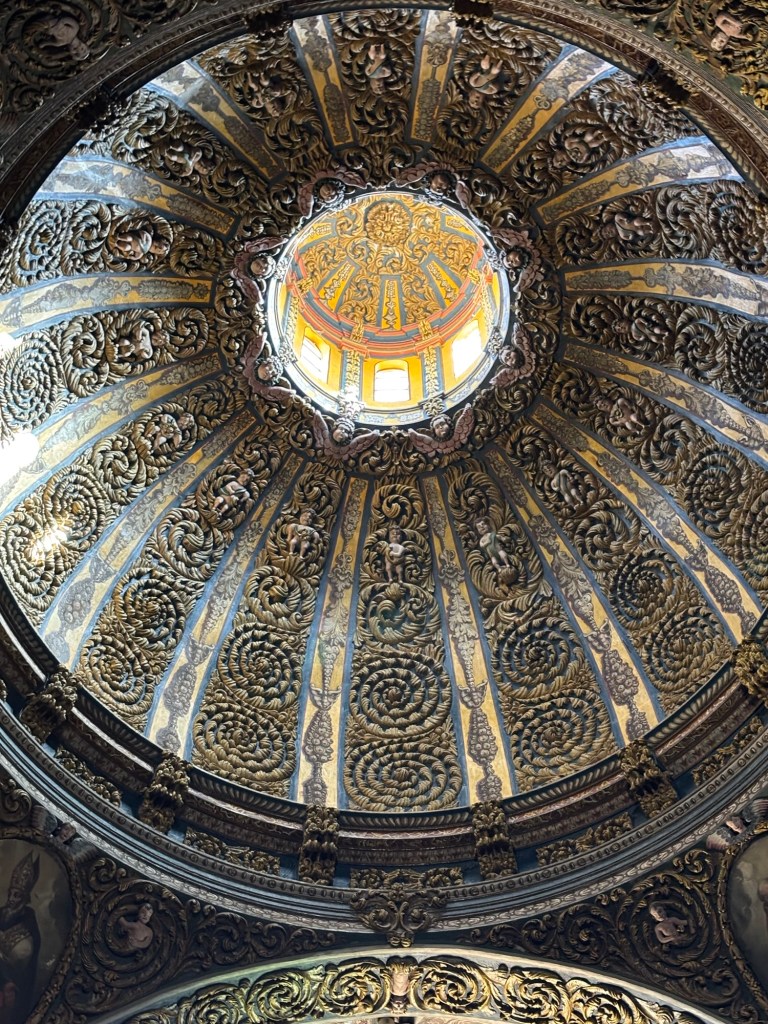
Guidebook author, Beene Bahrami, says these swirls “aren’t simply decorative; they also express the dynamic energy that locals feel in this place.” I concur, there’s some sort of positive flow going on there.

Now that I know more about the Black Madonnas, it was exciting to see this one again. I don’t think I really noticed her 12 years ago; she was one of the many figures on the retablo. Having seen the Virgens in Pamplona, and Estella, I could put this one in context.
The organ!


When I came downstairs from the choir and started circulating around the church with my head cocked back, a local lady came up to me and began an impromptu history tour in Spanish! Instead of saying “lo siento, no comprendo,” I listened as hard as I could, and asked some questions in Spanish, which she answered, and kept going in rapid fire Spanish. I wondered if I was downloading Spanish comprehension somehow, because I could understand quite a bit of what she said.
She was as much a lover of the church as so was and I totally enjoyed the tour. At the end, I asked if I could take her photo and she agreed.


“Hay gótico,” she said with emphasis. She is gothic from the 14th century, and is fine wood, with almond eyes. She was cleaned years ago so no longer has the Black Madonna look.
“Like the Virgen in Monserrat?” I asked? “No, she is Moreno,” At least that’s what I can remember her saying and could translate.
After feasting my eyes and sitting in the space awhile longer, it was time to find some dinner on the square. It was worth the whole trip to Spain to see the church in Los Arcos again.
 One Footestep at a Time