
I fell in love with the Francés the first time I walked it twelve years ago. And I was walking fast, trying to keep up with the traditional stages, walking 20k+ a day. I remember thinking, “Wait, I want to see that!” But either I was moving too fast or I was just too tired to walk a couple extra kilometers off the Camino to see some of the places just off the Camino.
The ancient church of Santa Maria de Eunate was one of those places. I distinctly remember standing on the trail with my new Camino friend Monika at the crossroads for the road to Eunate, and her telling me I should take the detour. But I was way too tired to do an extra 3.5 K and back.
When I started planning this Pamplona to Burgos Camino, I wanted the freedom to take those roads I didn’t take before. I wanted to say yes to the detours. And I wanted to make sure to see Eunate.
On Sunday I had my chance to say yes. I left the cute albergue in Uterga at 8:00 and walked out of town with two young guys from Hong Kong then said goodbye to them where the detour to Eunate branched off.
It felt funny to leave the well-marked Camino, but I soon found that the road to Eunate was well-marked, too.


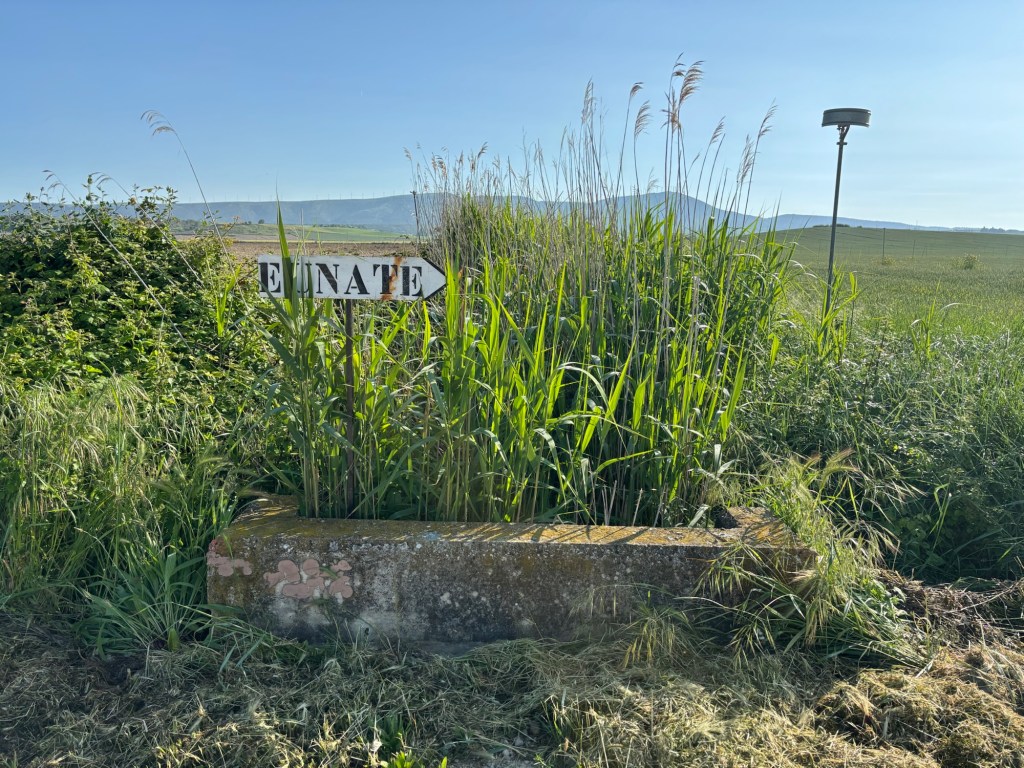
It was a quiet walk through open fields, some of which were recently harvested white asparagus, which is more popular in Europe than the green kind.
For a few moments I caught a glimpse of the church way out there.
The church of Santa Maria de Eunate is unique in a number of ways. One, it’s all by itself out in the countryside, which is unusual for a medieval church. No one really knows why it was built. It could’ve been a burial chapel, and there’s good reason to think it was built by the Knights Templar, who were very involved on the Camino. Its octagonal shape is similar to the lines of the church in Torres del Rio and the Church of the Holy Sepulcher in Jerusalem which were both built by the Knights Temples lar.
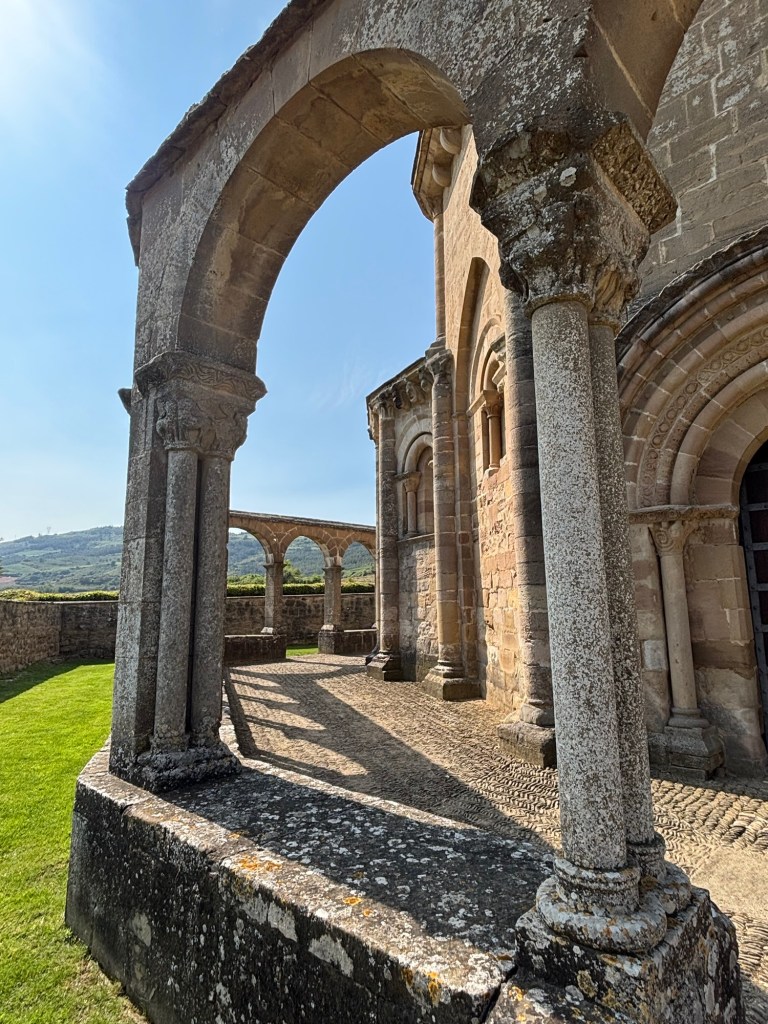
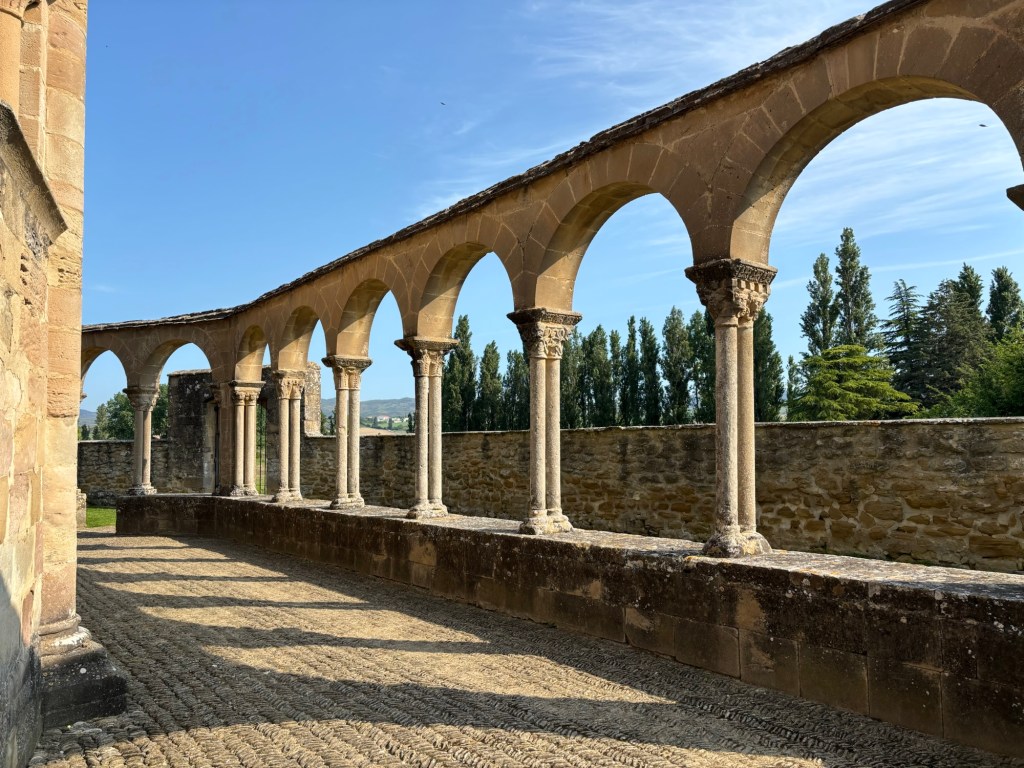
Eunate also has a separate unattached arcade surrounding it. That’s totally unique.
The word Eunate mean 100 doors in the Basque language. Scholars think that there’s sacred geometry involved at Eunate. There are 33 openings in the arcade. Jesus lived 33 years which is considered a sacred number. If you go around the arcade three times, you get 99, plus the front door equals 100.
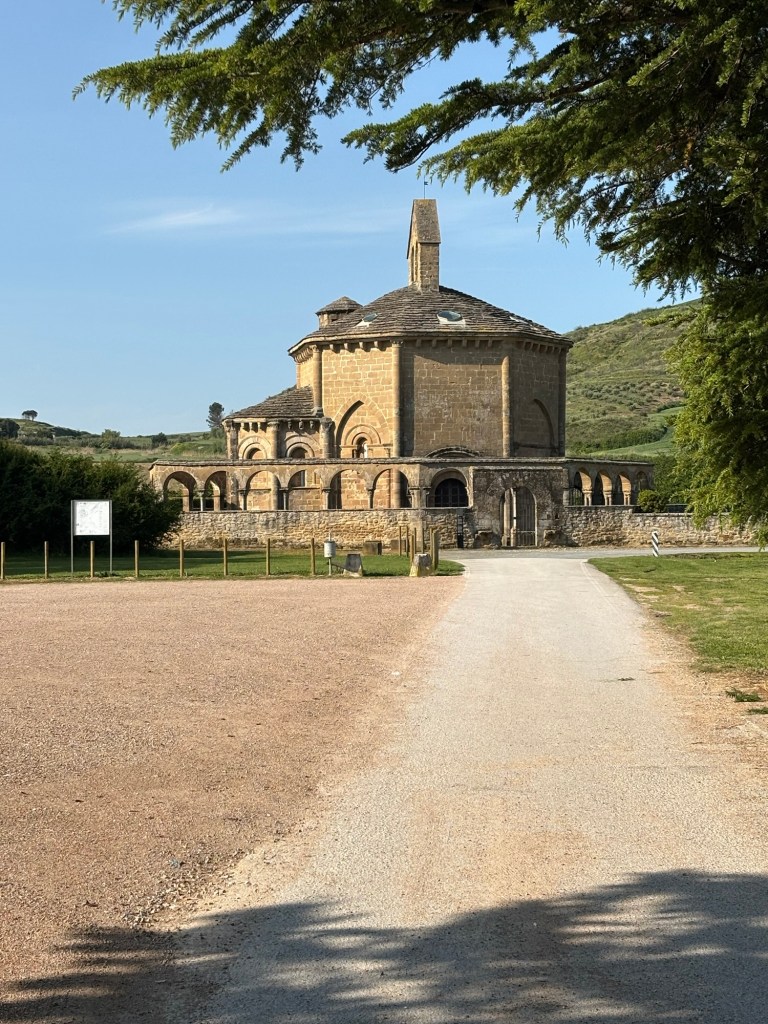
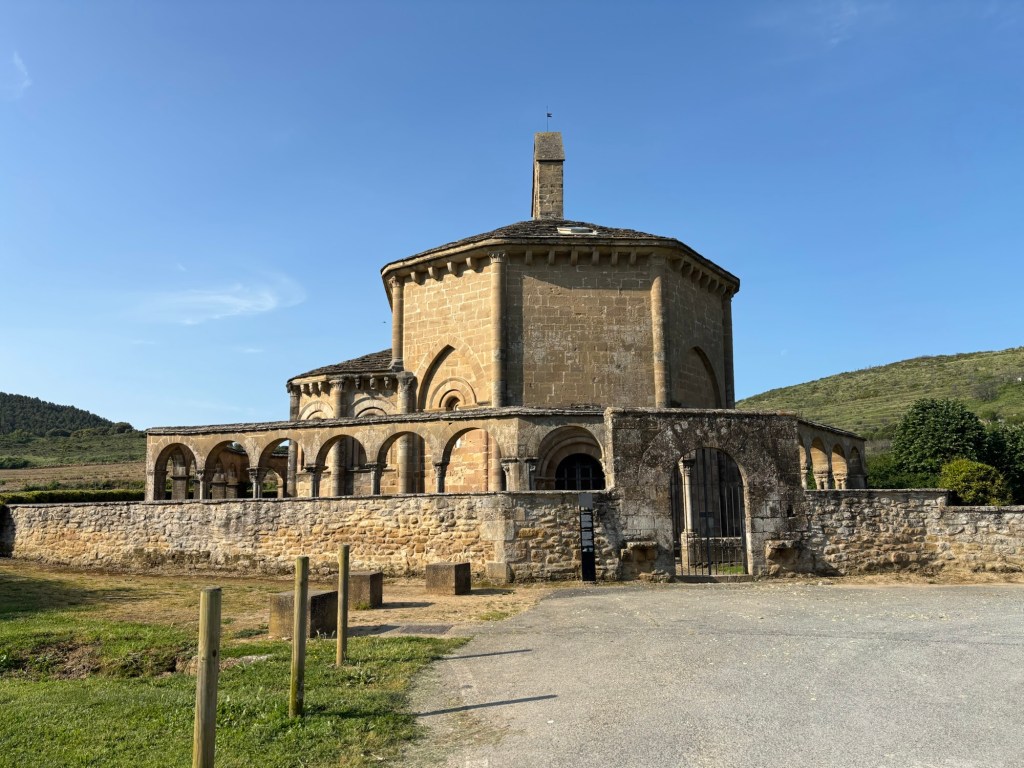

I walked up to it at 9:30, just before it opened. An American woman I’d met the night before at the albergue in Uterga was already there, and it was fun to have someone who spoke English there to talk about it.
Once the gate was open, I slowly took my time walking around the outside of the church.
It was built in the twelfth century, so it’s ancient, and like many churches along the Camino from that era, Romanesque in style.
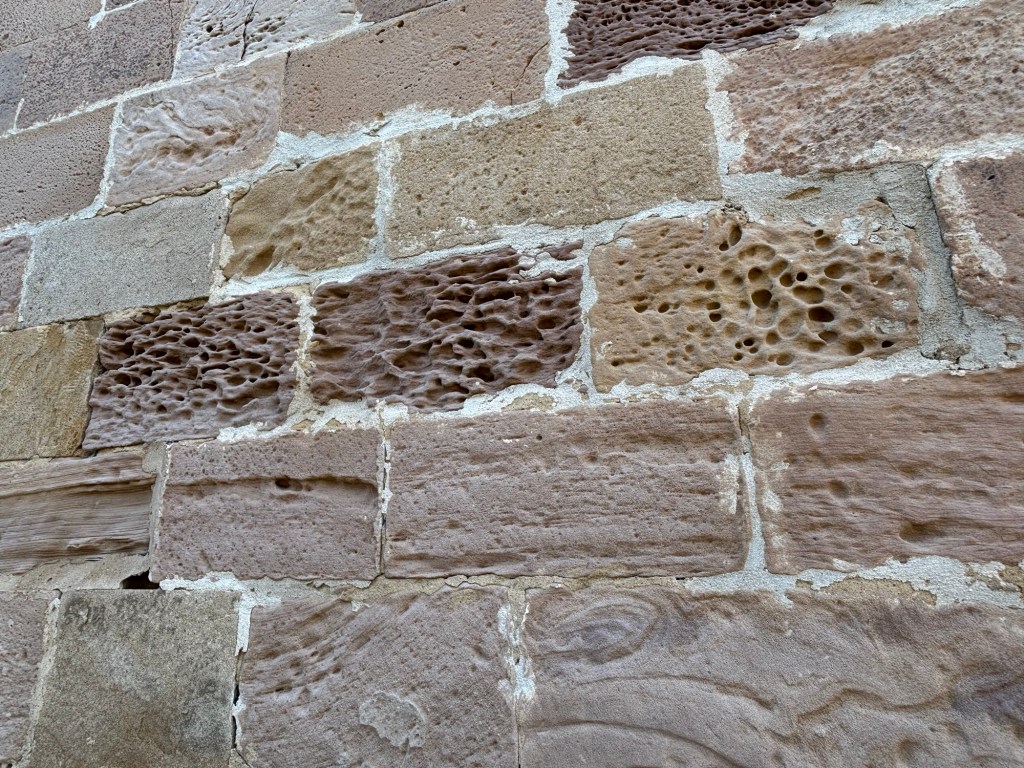
The stone is quite worn, and has an interesting texture.
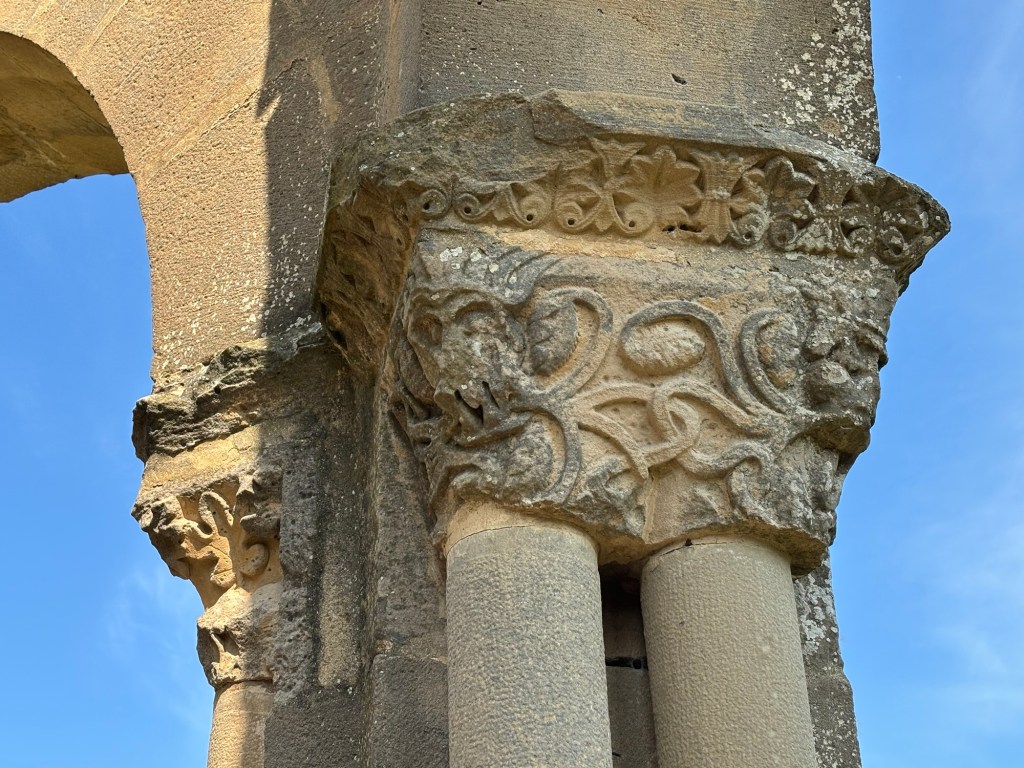
Looking up, there are carvings of heads around the edge. Some have noted that the faces, though worn, have features that could be Moorish.
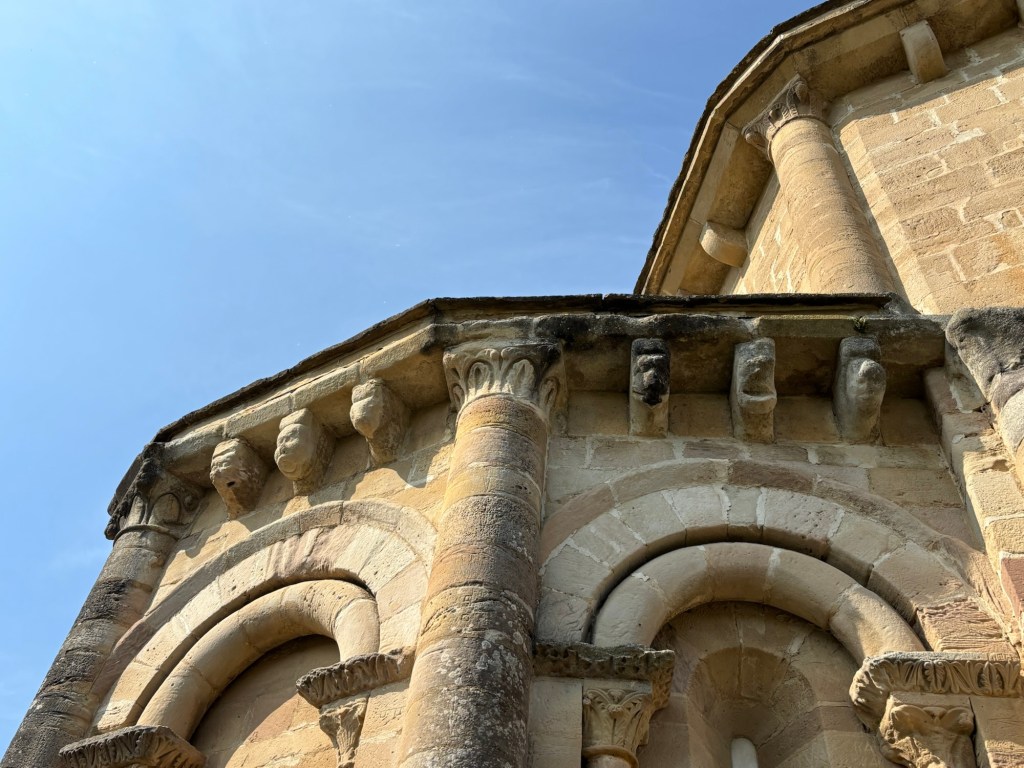
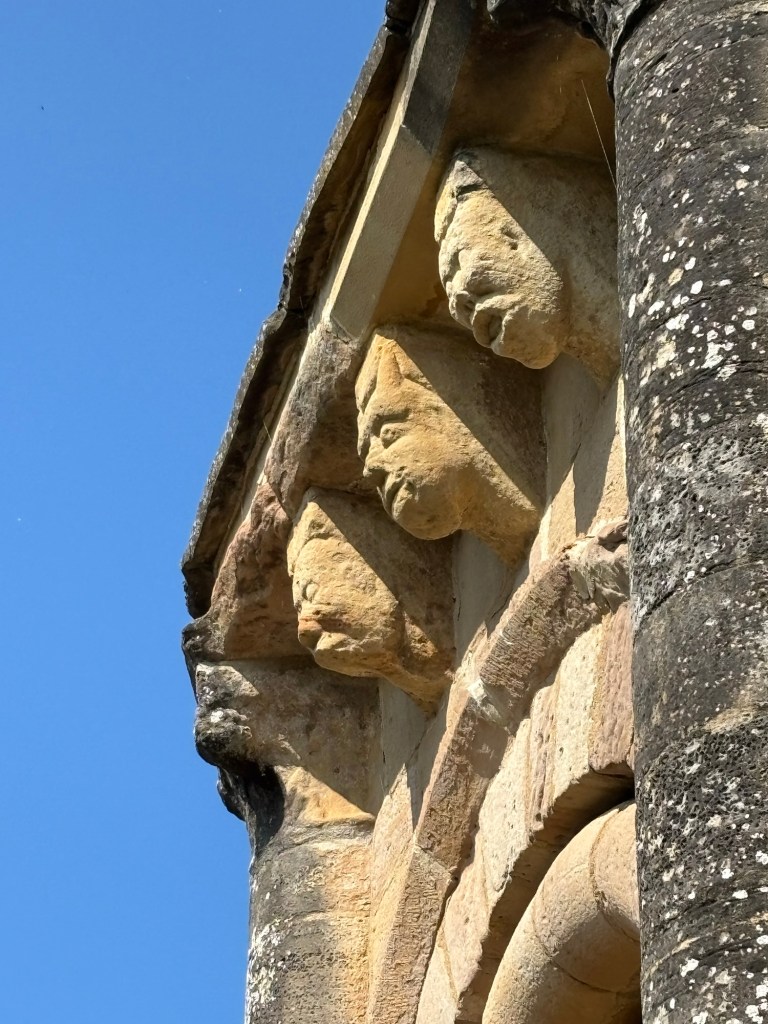
There were so many churches being built at that time along the Camino, that groups of artisans, artists and builders came from France and other parts of Europe and worked as teams on church after church. Historians think this could be one of the churches built by these international builders.
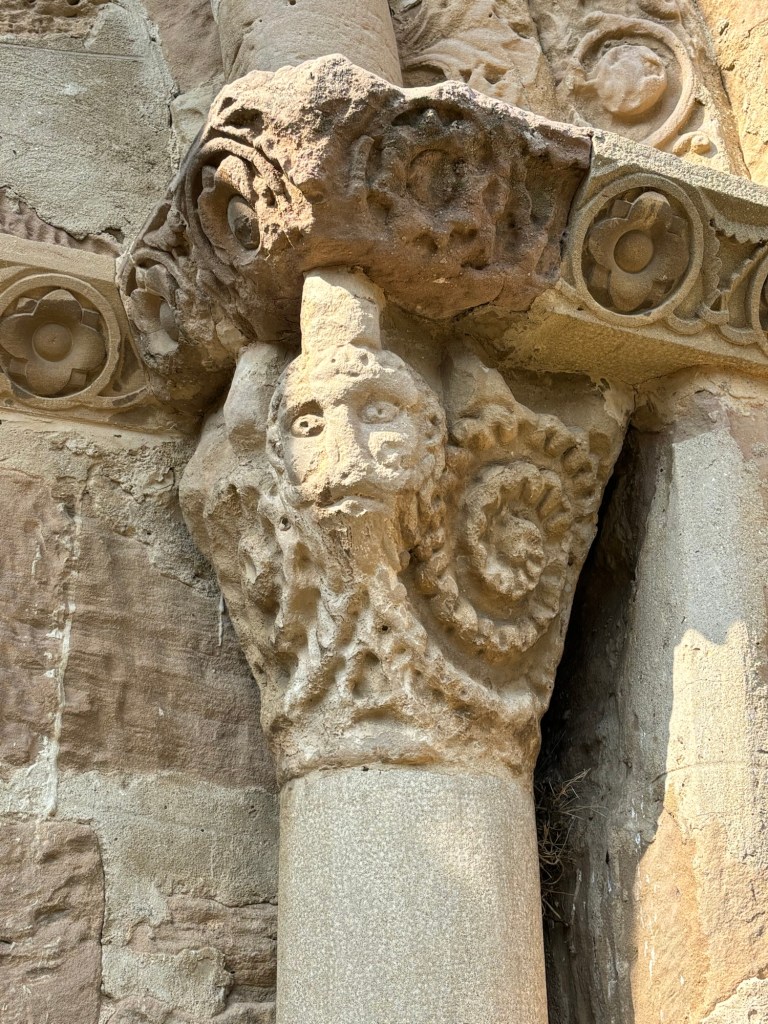
There are some fanciful carvings, too. On a corner capitol there’s a man with a spiraling beard.
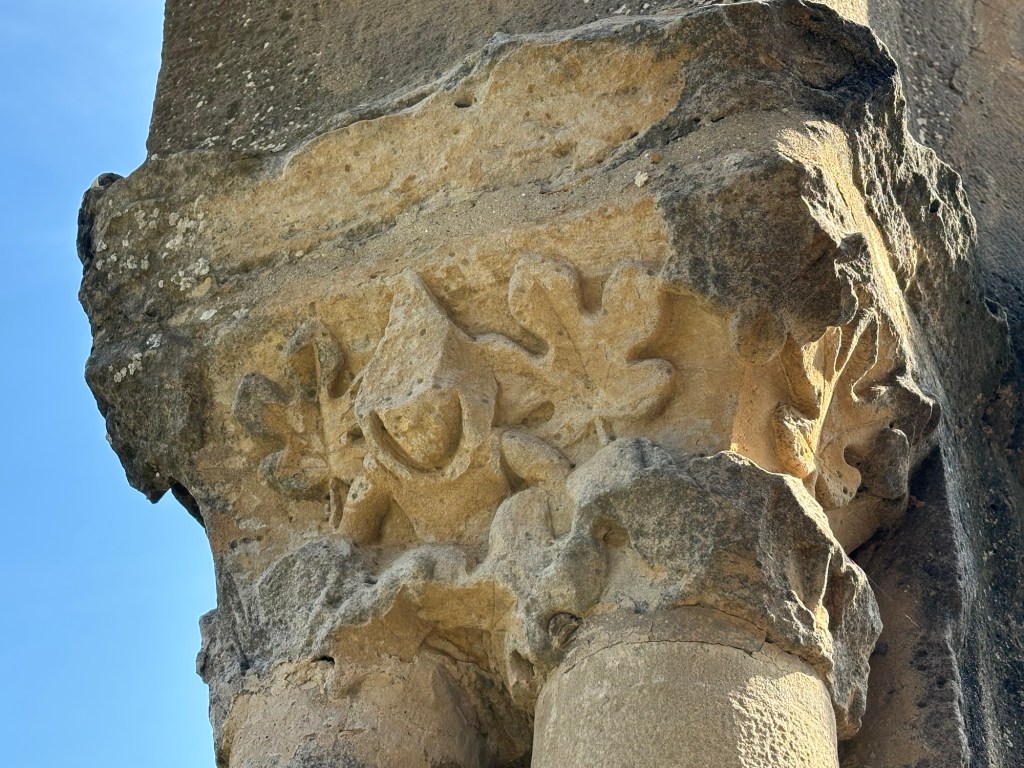
The capitols on one half of the arcade also have unusual carvings. What are those creatures that look like lions?

The arcade is quite beautiful the way it encircles the church. It does remind me of the circular movement of the labyrinth.
The interior is very simple. The windows are alabaster not stained glass. And there are alabaster skylights.
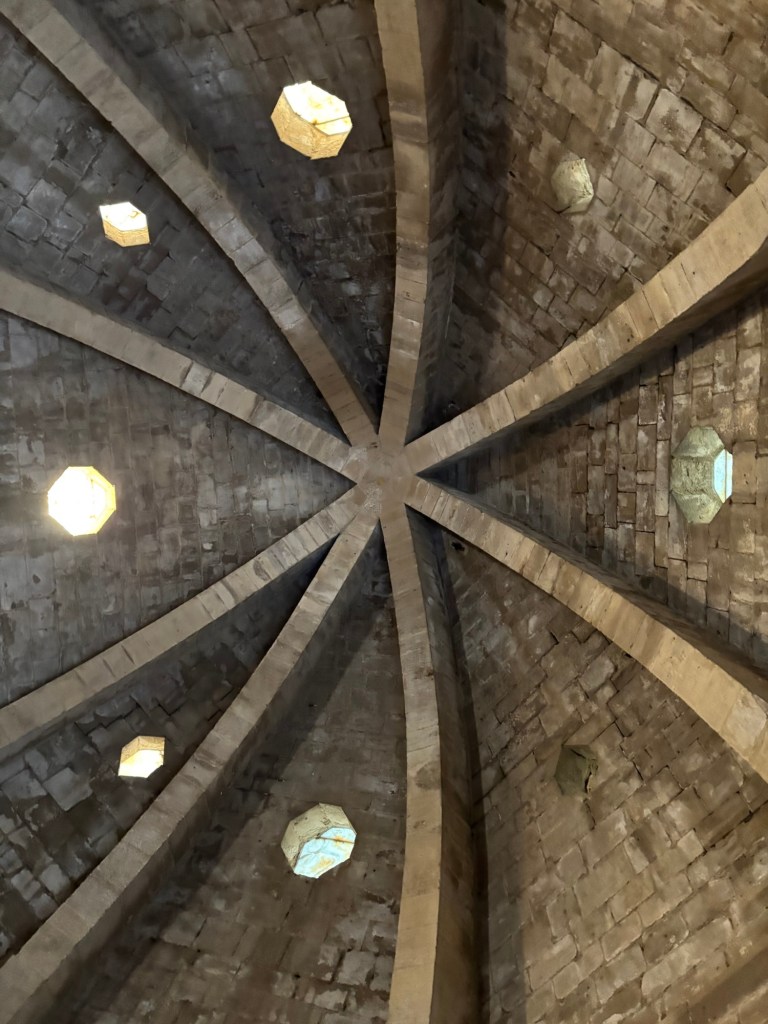

Now I wish I’d taken more photos inside.
At the center of the church sits the Virgen de Eunate. She is actually a copy because the original disappeared in the 1970’s. I’m intrigued by that because medieval Spanish Virgens had a habit of moving around on their own volition. And sometimes they were discovered in caves or trees.

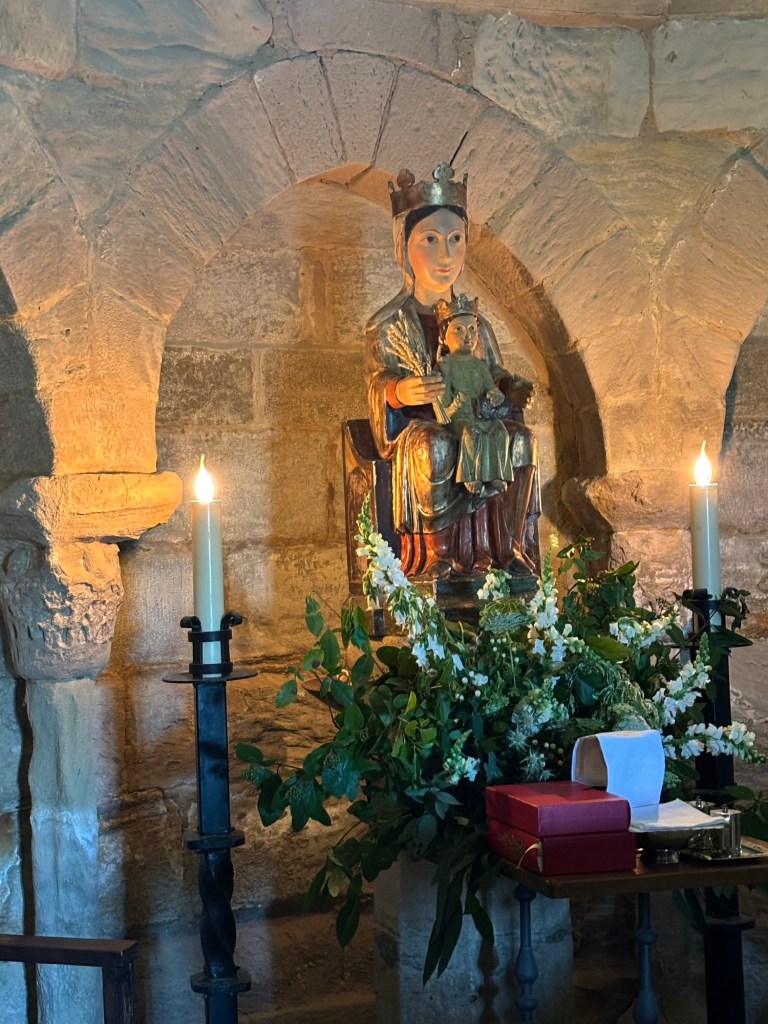
I sat in silence in the church taking in the shape of the space and the focus on the beautiful Virgen. She holds a sheaf of wheat as well as the Christ child, both symbols of abundance, it seems to me.
There is a quiet energy to the space, a barely perceptible feeling that I enjoyed. I love how the apse has columns and an arcade that echoes the one outside. The church feels centered and almost modern the way its unadorned by gold retablos and random saints or the more usual impression of stained glass. The alabaster windows let in a quiet shaded light. The place feels grounded in the earth; it has been there for 800 years!
I was hoping there’d be a mass there on Sunday, but it’s only celebrated on special occasions. There’s an association of friends of Eunate that support it, and weddings are held there.
While I was visiting a group of people arrived with folding tables, food and wine, and set up a private party in the old albergue next door. They weren’t very interested in answering my inquiries. That’s ok, sometimes in Spain I realize that I am very much a guest from another culture.
When it was time to walk on to Obanos, I had some questions about the way back. Someone told me, oh no, don’t take that trail. Finally, I consulted Apple Maps and started down the trail anyways. It led through a field of wildflowers.
When I got to a T, I had to choose left or right on a wider trail that went into the bright green wheat fields. Just then, a Mom and her teenage son walked by and pointed me in the right direction towards Obanos. They said “Buen Camino” and walked on talking animatedly together. They reminded me a bit of the Virgen and her son at Eunate.

and Obanos
I’m so glad I took the road not taken, and said yes to Eunate.
 One Footestep at a Time