Author Archives: bethlindfoote

Obanos to Cirauqui, 10k

I said my good-byes to Elena, the world’s warmest host, and walked out of Obonos towards Puente La Reina. My destination was Cirauqui, 14k away.


Obanos seemed to be very prosperous, with lots of new houses, some of them substantial! I didn’t remember Obanos being that big in 2013.

In less than an hour, I entered Puente La Reina. The first thing you see on the outskirts of town is Hotel Jakue. That’s where I stayed with my Camino buddies in 2013. It has something for everybody: a hotel and an albergue, and private albergue rooms. I remember pilgrim dinner being fun and my friends kidded me for “working the room.” I’d just left my position as associate rector, so I was used to circulating on purpose. It was fun to see it again.

There were two artistic treasures I wanted to see in town, the Y-shaped crucifix and the Black Madonna. The crucifix was in the first church walking into town.

Y-shaped crucifix in Puente La Reina

The crucifix is thought to have been donated by a German pilgrim when the second nave was built in the 14th century. Some think it has a connection to the Knights Templar. Its shape has also been linked to something called The Game of the Goose, a medieval children’s game set on the Camino. Geese were associated long ago with fertility and the sacred feminine spirit in pre-Christian times. There’s a tradition that signs in the shape of the goose foot can be found along the Camino. The shape of the goose foot is Y-shaped like this crucifix, so some think there’s a connection.

Beneath the crucifix there was a book to write prayers in, which I did. I’ve been praying for our country all along the Way.

I didn’t see the Black Madonna, but I discovered an interesting statue of St. James. All along the Camino you see statues of St. James, the Pilgrim. This one was especially handsome, and is known as Santiago Beltza or Black St. James, like the Black Madonnas.

Santiago Beltza

Then it was time to cross the Queen’s Bridge, Puente La Reina, over the river. It was built by one of the Queens of Navarra in the 11th century to facilitate the heavy pilgrim traffic at the time. It’s stunning. The open spaces in the bridge are for when there’s heavy water flow.

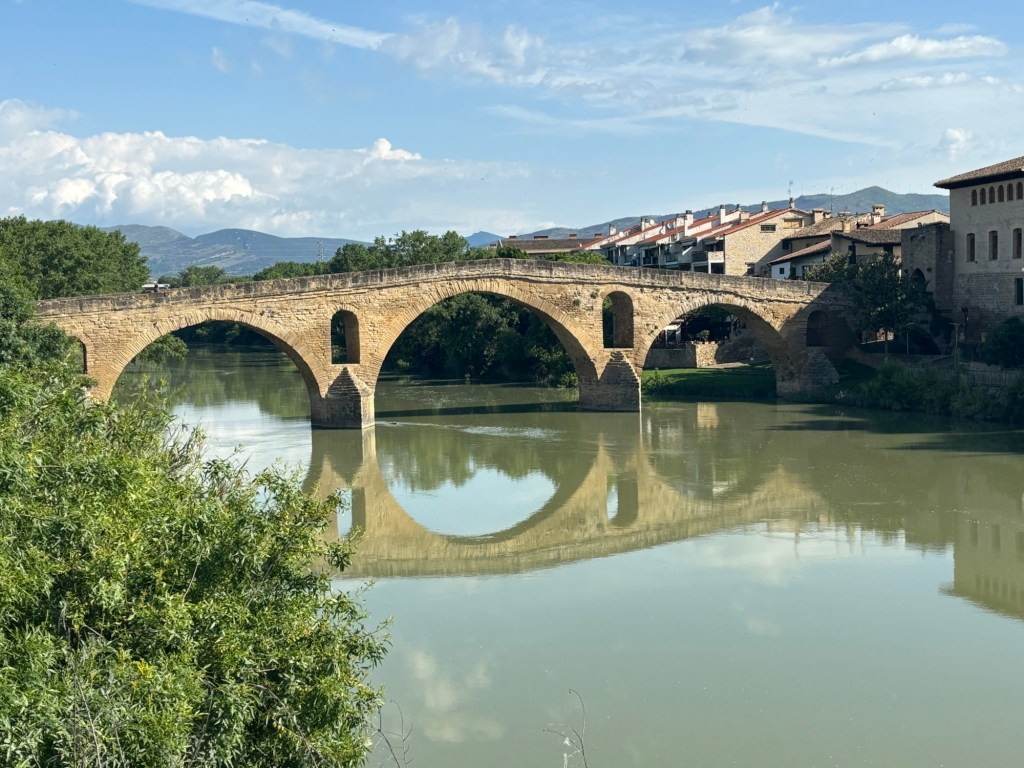
Puente la Reina

I thought I remembered what the trail was like after the bridge but I was wrong. Soon I was walking way out in the woods and for the first time I thought I could be lost, and, for the first time I felt a little vulnerable on the Camino. The trail went up steeply into pine woods; it felt like Tahoe. What spooked me was seeing no pilgrims for over an hour. Finally I saw several pilgrims pushing their bikes uphill, it was so steep.

Tough part of the trail

After sitting on a Camino mile marker to catch my breath, and eat a tangerine, I made it to Maneru, which also seemed much bigger than I remembered. The path then opened into open green wheat fields, with fluorescent red poppies, and a dark sky.
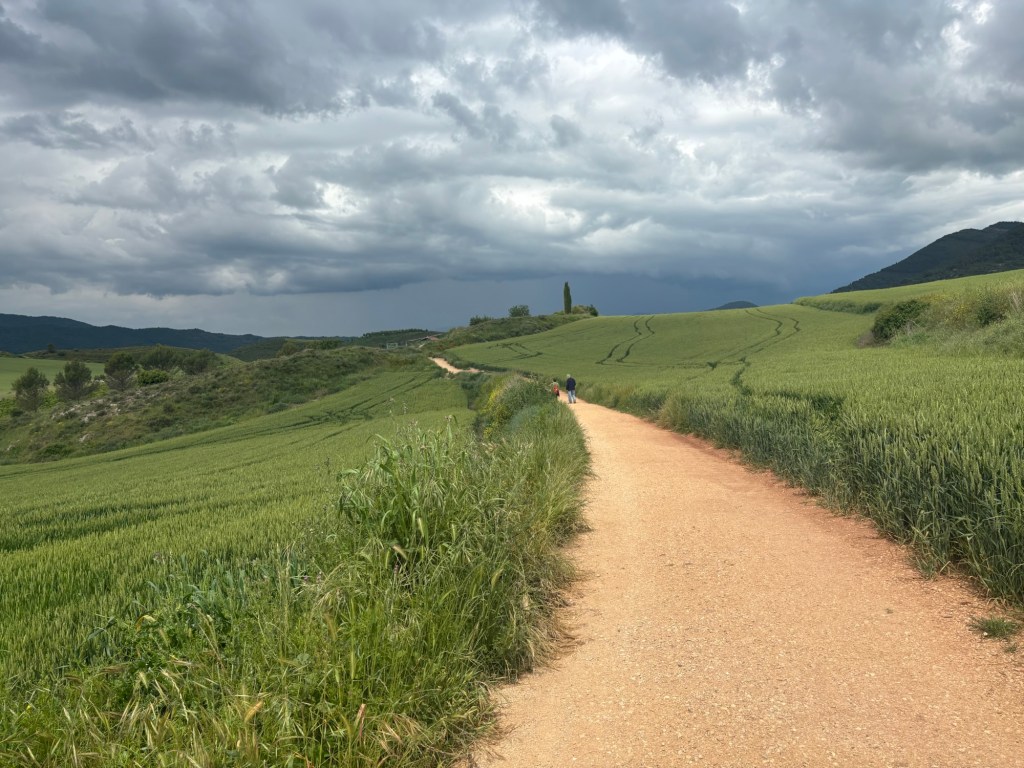
Path headed to Cirauqui
Ahoy Cirauqui!

I had to pick up the pace to beat a thunderstorm brewing overhead. Cirauqui is a compact hill town with a church on the top. I was headed to Albergue Maralotx.

Albergue Maralox at the top of the hill
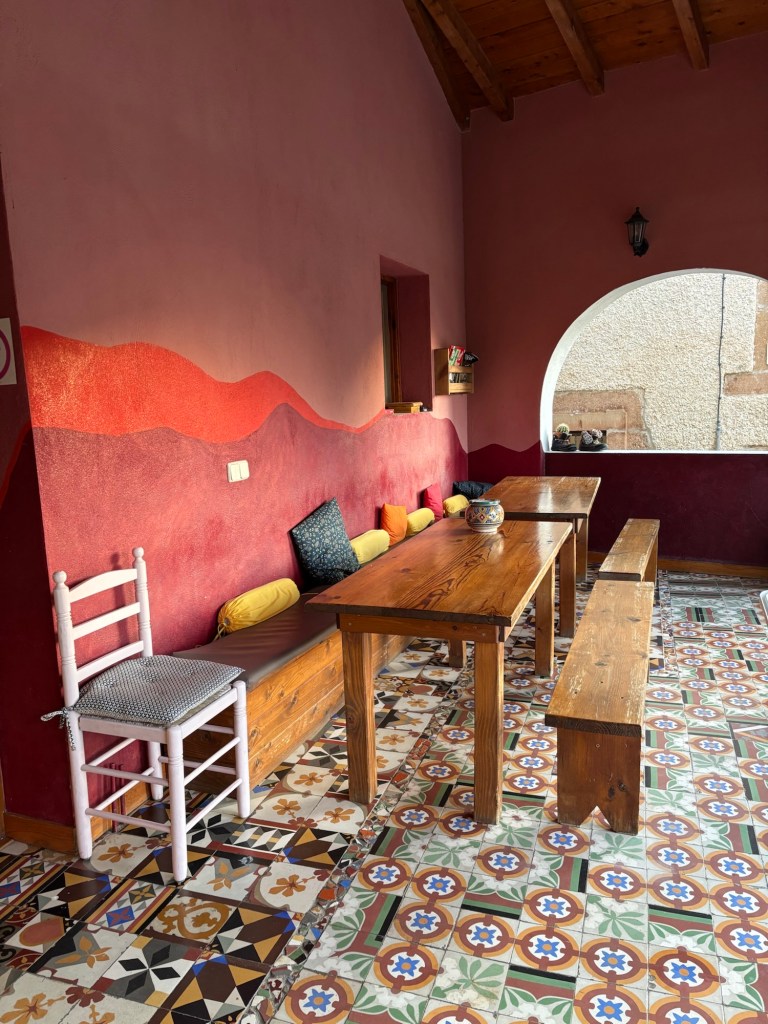
Interior of Albergue Maralotx with tile and antiques
Terrace where I sketched

I was the first to arrive at 1:00 so my worries about possibly having a top bunk were all for naught. I got a cozy lower bunk, and was happy to see a French female pilgrim I’d run into earlier on the path unpacking her pack on the bunk next to me.

She’d been struggling to find her rain gear in her enormous pack as the sky darkened on the way to Cirauqui. I’d shared that I was staying in Cirauqui. She said she didn’t have a reservation, and then our ability to communicate between French and English broke down, and I said Buen Camino and walked on.

It turned out that our albergue wasn’t sold out so she was able to stay. As we were unpacking our stuff for the night, I realized one reason her pack was so big; she was carrying a full-sized CPAP machine with multiple hoses and masks!

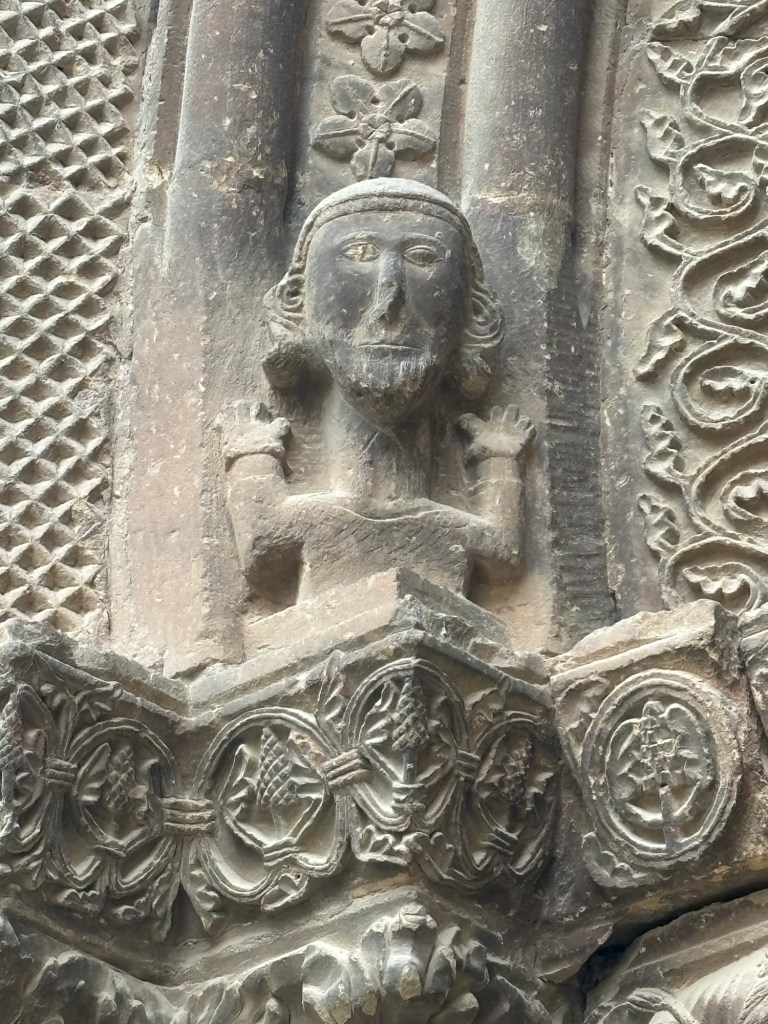
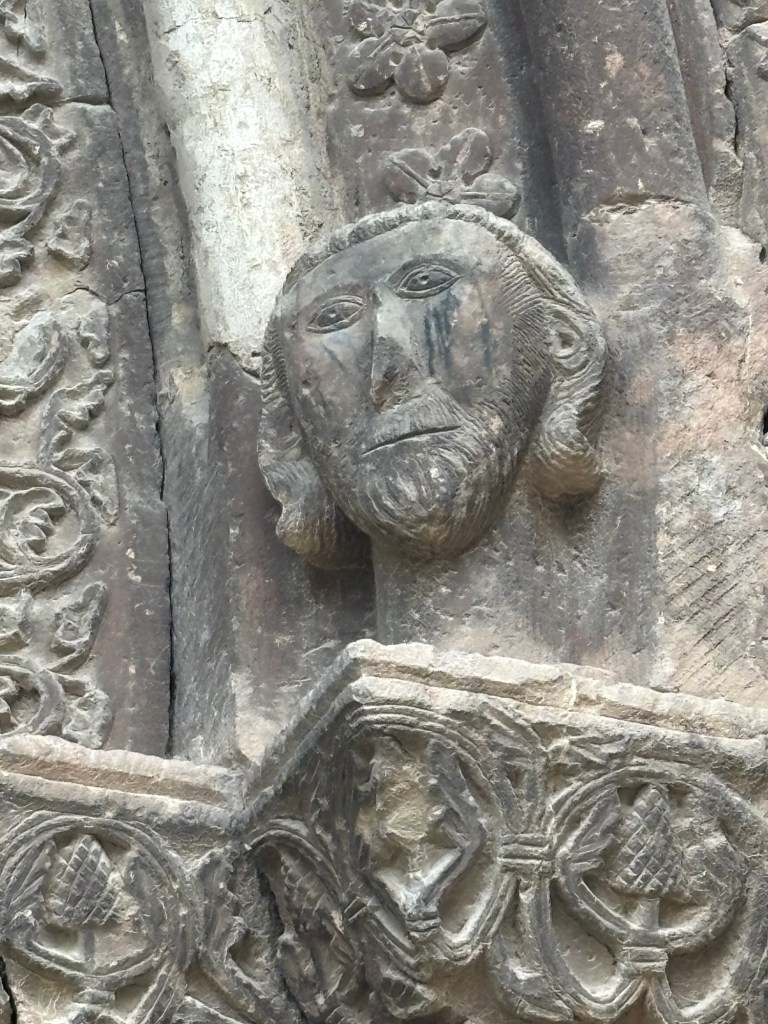
Before the rain started I was able to check out the church, which faced the albergue. It looked to be medieval with 18th century classical updates. It had a fascinating early medieval entry portal. I’d hoped that it would be open but the host said it was open once a month at the most and on their feast day.

Soon another French woman joined us in the room, and she revealed that she also had a full sized CPAP machine! There was a lot of laughter in the room and solidarity. They were also old-school pilgrims carrying all their stuff and not making reservations.

I also sensed they were glad to have each other to talk to. I’ve noticed that people who only speak French or only German can have a more challenging time on the Camino. Having some facility with English and/or Spanish are the common denominators.

I realized that the host was working solo, doing everything that needs to be done once the pilgrims arrived. He checked people in, showed them their bunk, which can be involved when it’s a three story building.

The official office, tiny bar and dining room were accessed by another door on the side of the building. He was in charge of selling snacks and glasses of wine, too. I was appreciative of the way he made it clear to us that he could do one thing at a time in a non-defensive way. He seemed to be a British expat who spoke fluent Spanish.

Interesting medieval primitive figures

Walking shorter stages gives you more time to hang out in the afternoon, and I really enjoyed sitting on the terrace and sketching the view of the church, and some architectural details. The rain and thunder made it cozy.

Dinner was downstairs in the former wine cellar. It was an extra 10€ and well worth it. There was salad and a garbanzo stew, red wine, and flan. The host was serving everything; I think his wife was the chef,

I sat next to a French guy who had started walking in le Puy. I said I was American and he said “Trump? and made boxing motion with his fists and laughed. I laughed too. I’m always impressed with pilgrims who hike across France.

Across the table was a couple from North Carolina who were Episcopalian. We hit it off and after dinner they showed me their private room (the only one in the albergue). I felt somewhat embarrassed because before dinner I’d told the host I’d settle my bill but instead went upstairs with them. When I came down he said no worries he’d charged my card, (which was fine), since I’d booked through booking.com. But I felt a little high maintenance.

The other folks in the bunk room were a Spanish couple who talked on FaceTime with their family at great length before dinner, and a couple of German men. Everyone was over 50.

Everyone turned in early, and there was no snoring, (thank you God for those CPAP machines)

Categories: Camino de Santiago | Tags: , , , | Leave a comment

Obanos

After my detour to Eunate I spent the night in Obanos, a prosperous village close to Puente la Reina.

Casa Raichu

I stayed at Casa Raichu, technically a Casa Rural, a kind of hotel in Spain. I really enjoyed this place. It was a new four story house run by the owner, Elena, who was super hospitable. She welcomed me at 1:00 as the first guest, and got me settled: told me to take off my boots, took me upstairs to see my room (shared bathroom) and told me the times of meals, then checked me in with US Passport and Pilgrim Passport. We conversed in animated voices, all in Spanish. (Or, she met me where I was on the language continuum.)

The place was super clean and she had a guy swabbing all the marble and tile floors the same time as the robo vacuum was patrolling the common space. Impressive!

Around 3:00 a party of 6 Korean pilgrims arrived, and an Australian couple, who had walked from Le Puy, France.

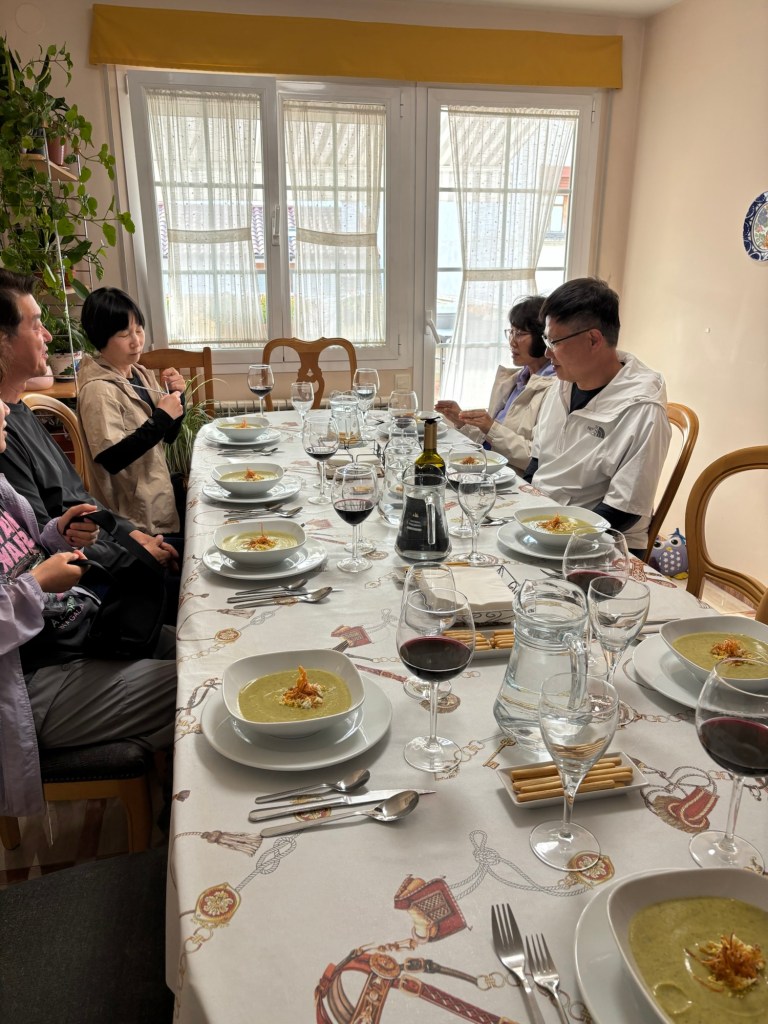
We were served excellent local Navarra red wine on the terrace, and had some social time before sitting down to a generous meal at the dining room table.

Dinner at Casa Raichu, Cream of Zucchini soup

After dinner we all retreated to our rooms to regroup for the morning. I took advantage of the laundry service, and did my usual sorting of clothes and items into what I was going to carry the next day and what I was going to transport in the duffle. I seem to be perennially losing things and then finding them again, and annoying myself,

I enjoyed the view from my window looking out over town, and observing some neighborhood dynamics. There was a big dog across the way on a balcony who liked to bark, and the owners were shushing him over and over. People live close to each other in Spain. I was looking over someone’s back patio, and across to the balconies of another building.

Clouds formed, and then there was thunder and lightning and heavy rain as I went to sleep.

In the morning the air was fresh, and it was time for breakfast at the dining room table with fellow guests. One of the guys from Korea asked if I knew the song, “Hotel California,” and we had a good laugh. Then it was time to take off and walk the 10k to Cirauqui.

Categories: Camino de Santiago | Tags: , , | Leave a comment

Roads not taken, revisited: Eunate, 9.2k to Obanos

I fell in love with the Francés the first time I walked it twelve years ago. And I was walking fast, trying to keep up with the traditional stages, walking 20k+ a day. I remember thinking, “Wait, I want to see that!” But either I was moving too fast or I was just too tired to walk a couple extra kilometers off the Camino to see some of the places just off the Camino.

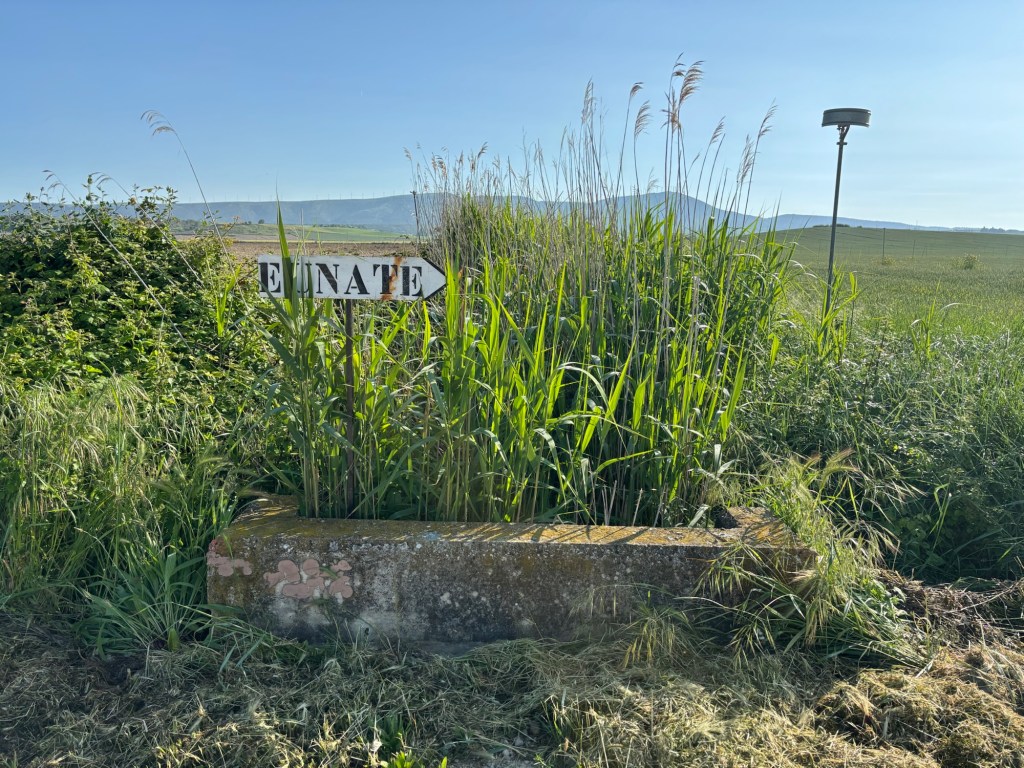
The ancient church of Santa Maria de Eunate was one of those places. I distinctly remember standing on the trail with my new Camino friend Monika at the crossroads for the road to Eunate, and her telling me I should take the detour. But I was way too tired to do an extra 3.5 K and back.

When I started planning this Pamplona to Burgos Camino, I wanted the freedom to take those roads I didn’t take before. I wanted to say yes to the detours. And I wanted to make sure to see Eunate.

On Sunday I had my chance to say yes. I left the cute albergue in Uterga at 8:00 and walked out of town with two young guys from Hong Kong then said goodbye to them where the detour to Eunate branched off.

It felt funny to leave the well-marked Camino, but I soon found that the road to Eunate was well-marked, too.

It was a quiet walk through open fields, some of which were recently harvested white asparagus, which is more popular in Europe than the green kind.

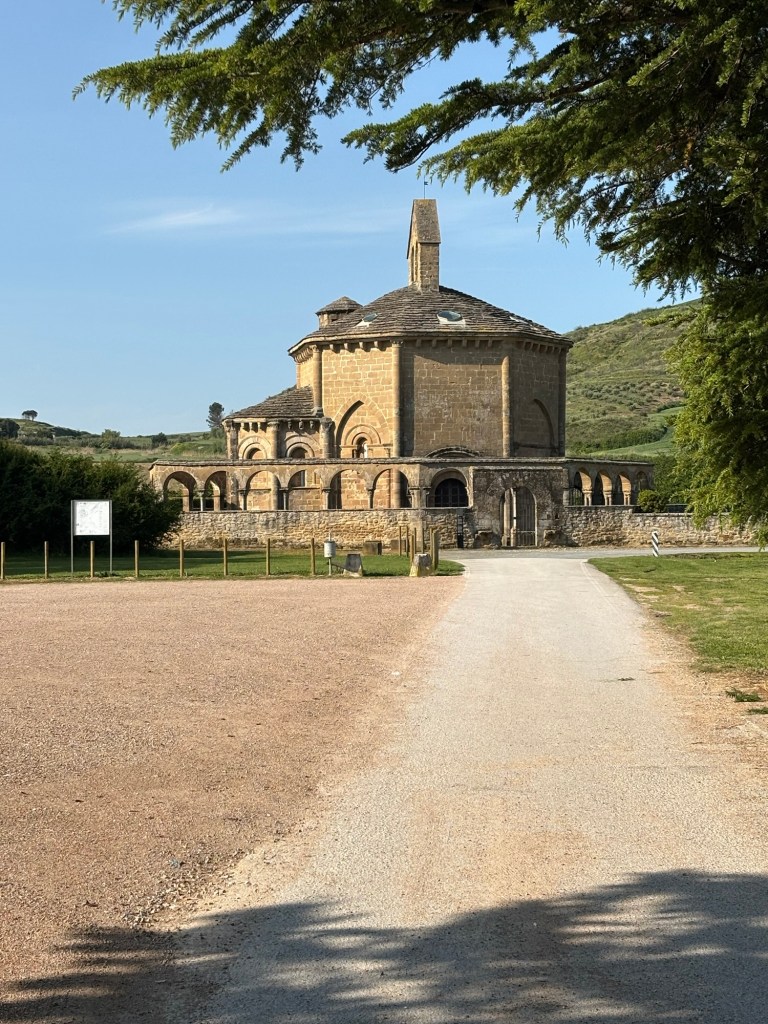
For a few moments I caught a glimpse of the church way out there.

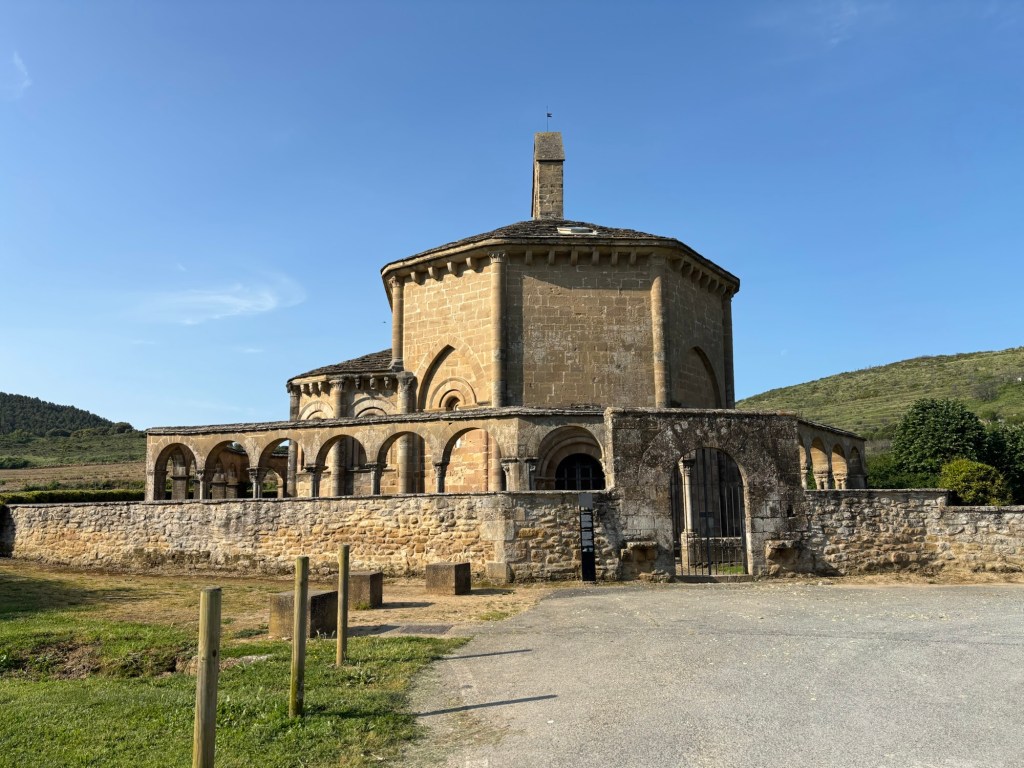
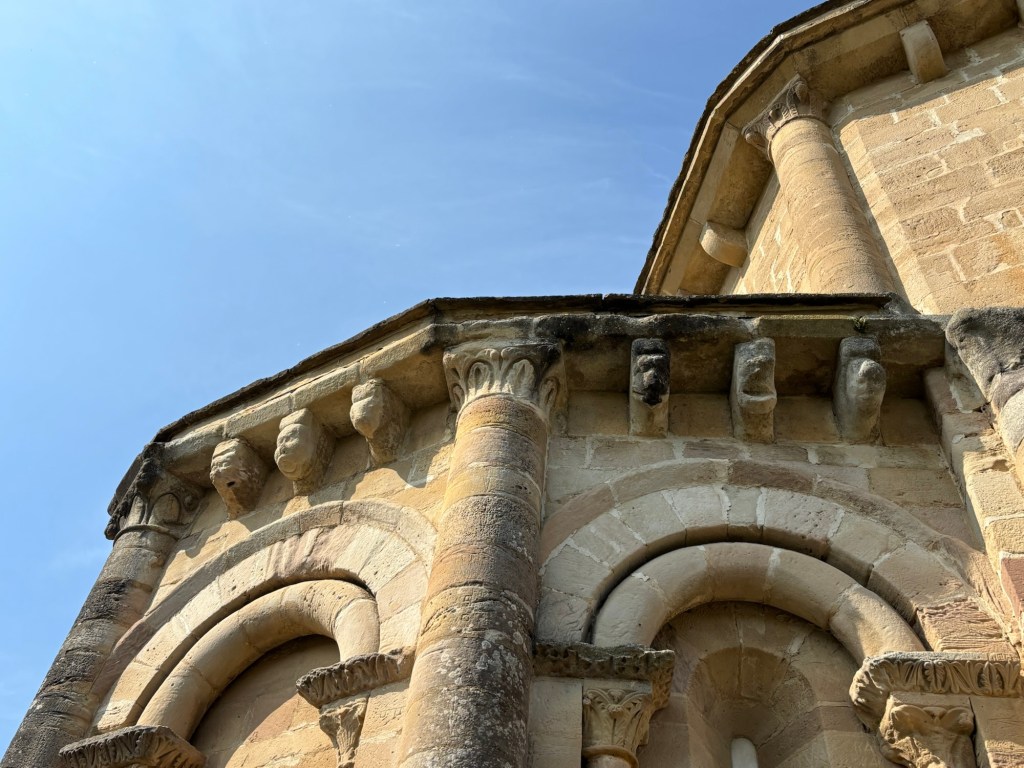
The church of Santa Maria de Eunate is unique in a number of ways. One, it’s all by itself out in the countryside, which is unusual for a medieval church. No one really knows why it was built. It could’ve been a burial chapel, and there’s good reason to think it was built by the Knights Templar, who were very involved on the Camino. Its octagonal shape is similar to the lines of the church in Torres del Rio and the Church of the Holy Sepulcher in Jerusalem which were both built by the Knights Temples lar.

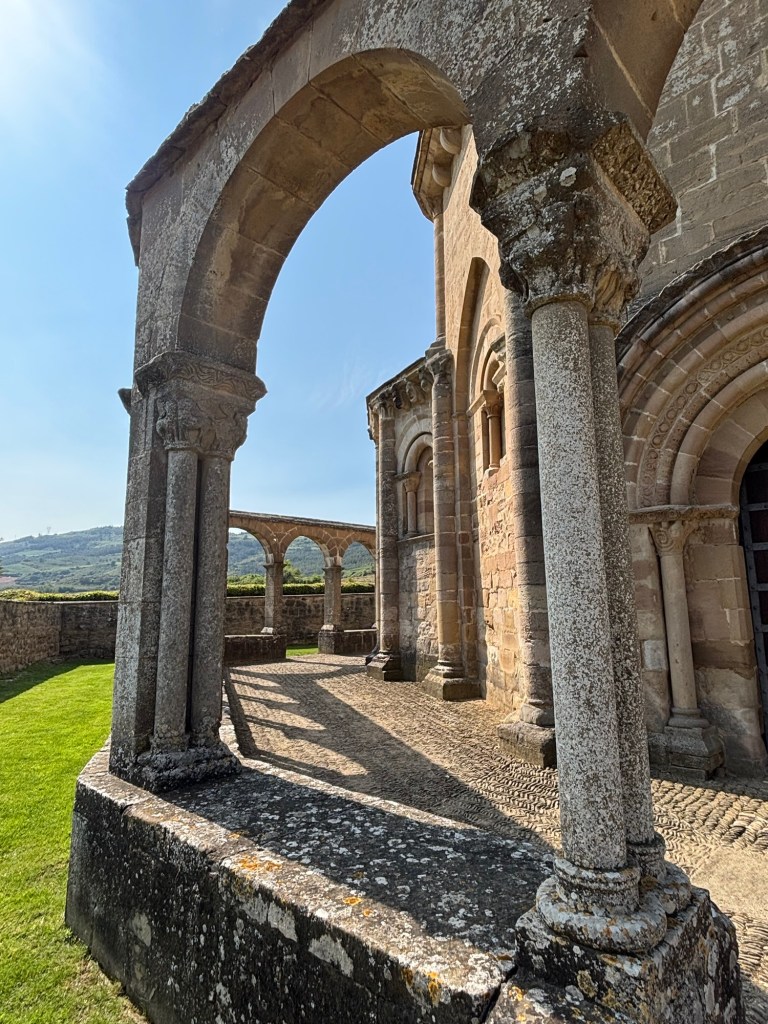
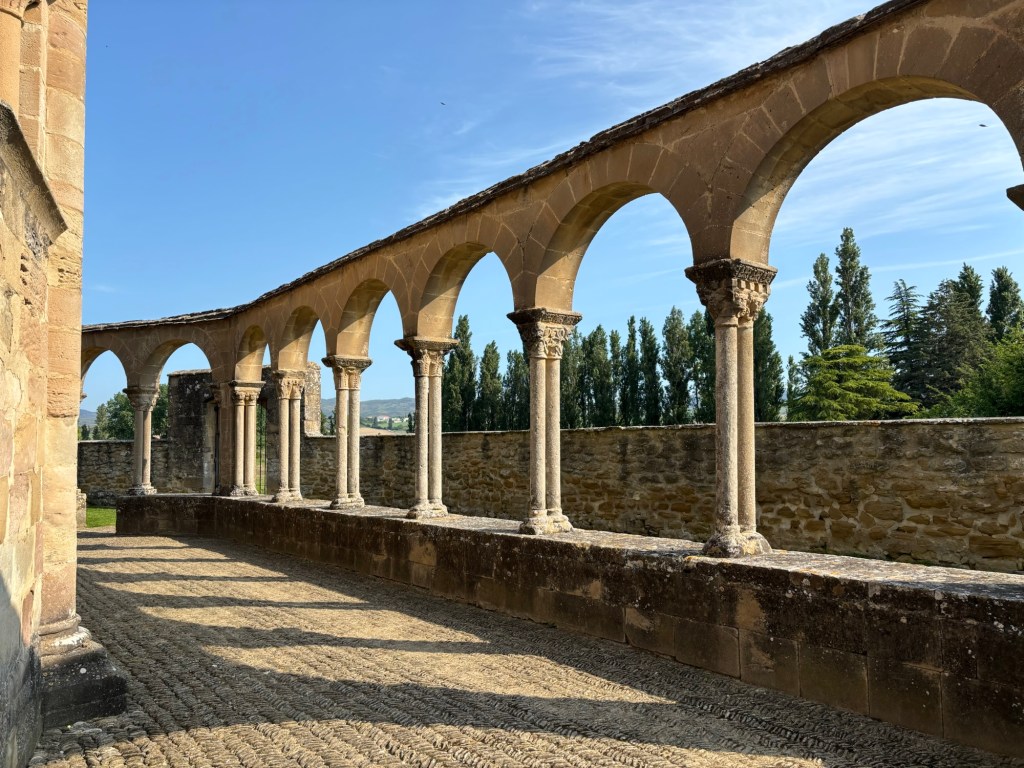
Eunate also has a separate unattached arcade surrounding it. That’s totally unique.

The word Eunate mean 100 doors in the Basque language. Scholars think that there’s sacred geometry involved at Eunate. There are 33 openings in the arcade. Jesus lived 33 years which is considered a sacred number. If you go around the arcade three times, you get 99, plus the front door equals 100.

I walked up to it at 9:30, just before it opened. An American woman I’d met the night before at the albergue in Uterga was already there, and it was fun to have someone who spoke English there to talk about it.

Once the gate was open, I slowly took my time walking around the outside of the church.

It was built in the twelfth century, so it’s ancient, and like many churches along the Camino from that era, Romanesque in style.

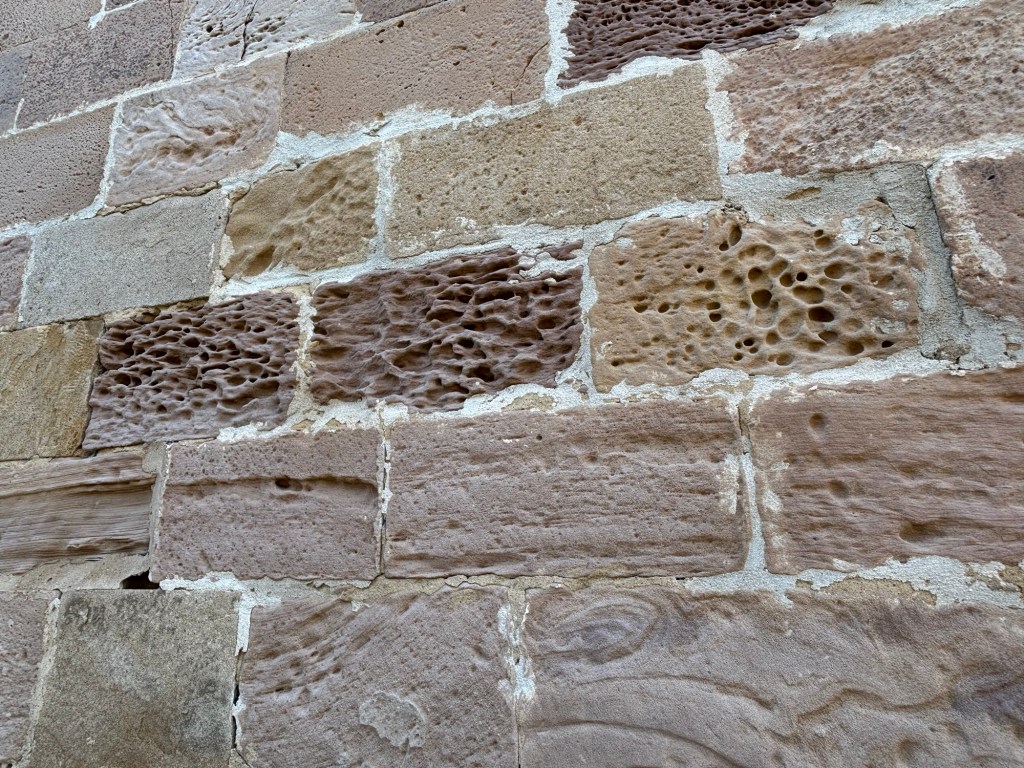
The stone is quite worn, and has an interesting texture.

Stone on outside wall of Eunate

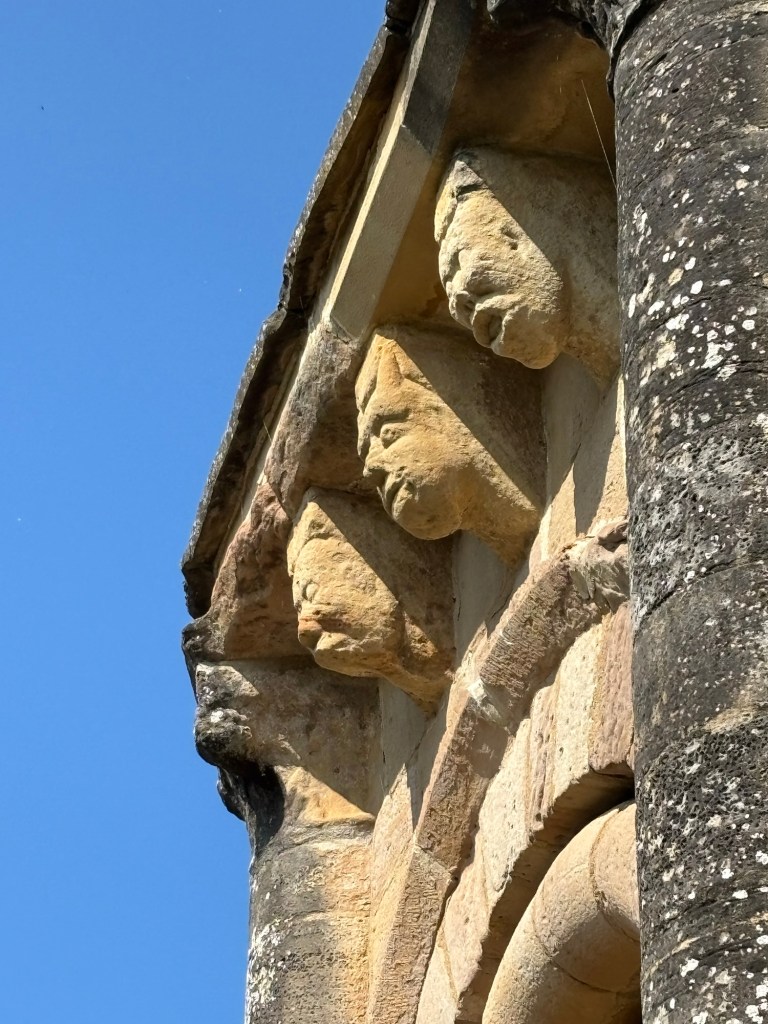
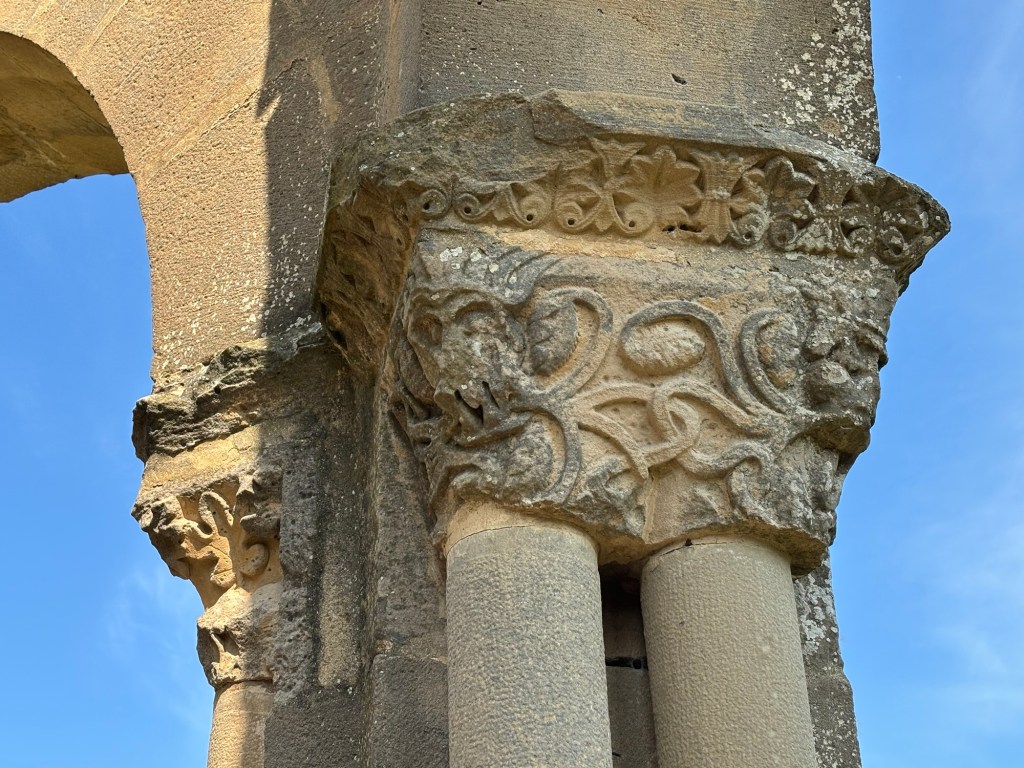
Looking up, there are carvings of heads around the edge. Some have noted that the faces, though worn, have features that could be Moorish.

There were so many churches being built at that time along the Camino, that groups of artisans, artists and builders came from France and other parts of Europe and worked as teams on church after church. Historians think this could be one of the churches built by these international builders.

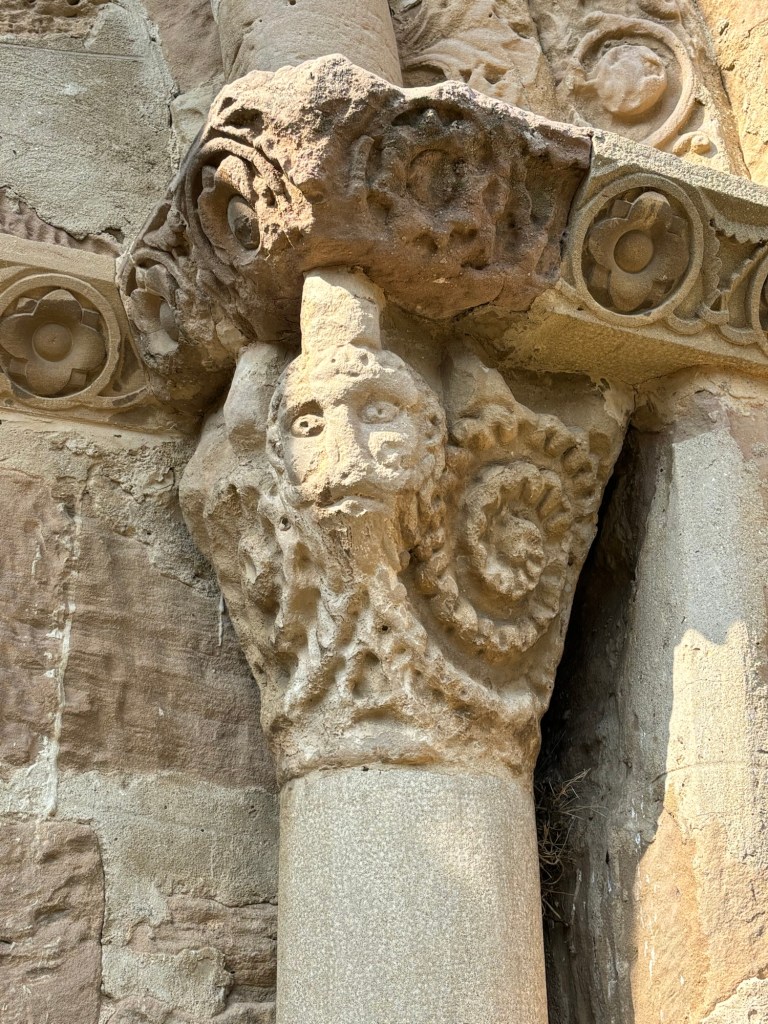
There are some fanciful carvings, too. On a corner capitol there’s a man with a spiraling beard.

A man with a spiraling beard

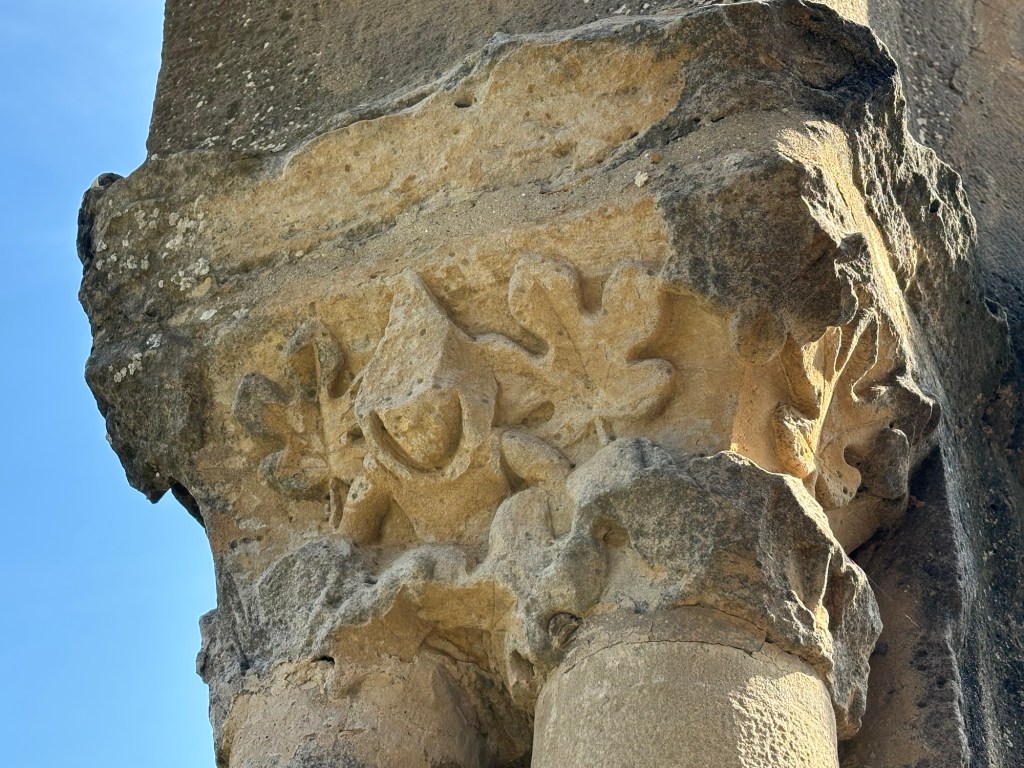
The capitols on one half of the arcade also have unusual carvings. What are those creatures that look like lions?

The arcade is quite beautiful the way it encircles the church. It does remind me of the circular movement of the labyrinth.

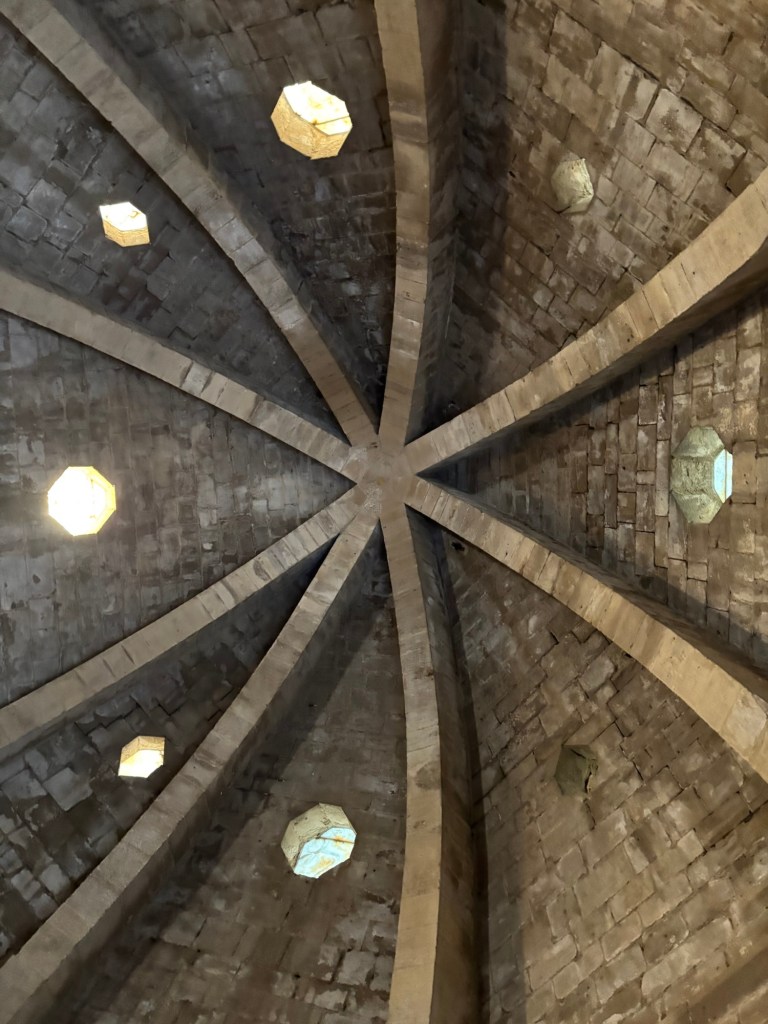
The interior is very simple. The windows are alabaster not stained glass. And there are alabaster skylights.

Now I wish I’d taken more photos inside.

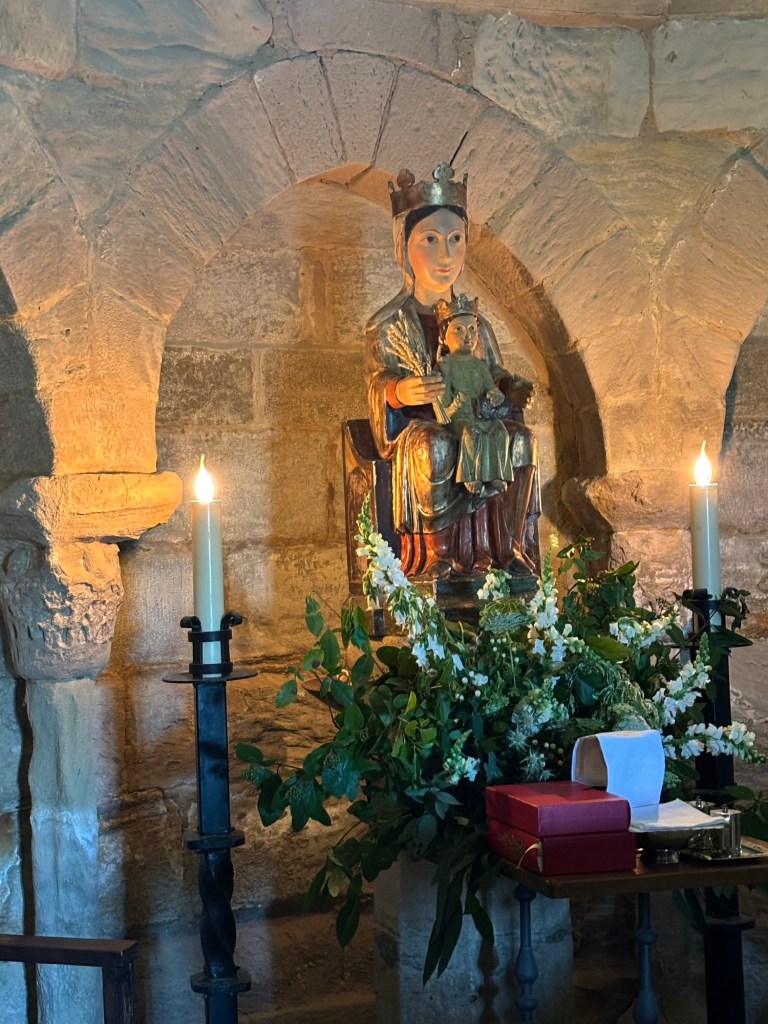
At the center of the church sits the Virgen de Eunate. She is actually a copy because the original disappeared in the 1970’s. I’m intrigued by that because medieval Spanish Virgens had a habit of moving around on their own volition. And sometimes they were discovered in caves or trees.

The Virgen from the opposite angle

I sat in silence in the church taking in the shape of the space and the focus on the beautiful Virgen. She holds a sheaf of wheat as well as the Christ child, both symbols of abundance, it seems to me.

There is a quiet energy to the space, a barely perceptible feeling that I enjoyed. I love how the apse has columns and an arcade that echoes the one outside. The church feels centered and almost modern the way its unadorned by gold retablos and random saints or the more usual impression of stained glass. The alabaster windows let in a quiet shaded light. The place feels grounded in the earth; it has been there for 800 years!

I was hoping there’d be a mass there on Sunday, but it’s only celebrated on special occasions. There’s an association of friends of Eunate that support it, and weddings are held there.

While I was visiting a group of people arrived with folding tables, food and wine, and set up a private party in the old albergue next door. They weren’t very interested in answering my inquiries. That’s ok, sometimes in Spain I realize that I am very much a guest from another culture.

When it was time to walk on to Obanos, I had some questions about the way back. Someone told me, oh no, don’t take that trail. Finally, I consulted Apple Maps and started down the trail anyways. It led through a field of wildflowers.

When I got to a T, I had to choose left or right on a wider trail that went into the bright green wheat fields. Just then, a Mom and her teenage son walked by and pointed me in the right direction towards Obanos. They said “Buen Camino” and walked on talking animatedly together. They reminded me a bit of the Virgen and her son at Eunate.

Local Mother and son on the path to Camino
and Obanos

I’m so glad I took the road not taken, and said yes to Eunate.

Categories: Camino de Santiago, Pilgrimage | Tags: , , , , , | 2 Comments

Coming down the mountain

I spent some time at the summit of Alto de Perdon admiring the view, recovering from the climb, and chatting with my fellow pilgrims. There seemed to be a batch of pilgrims who had started together from St. Jean at the same time. It was fun to chat about their experience of crossing the Pyrenees. I haven’t really regretted starting in Pamplona rather than St. Jean. It occurred to me that Alto de Perdon is my big opening challenge this time.

Sculpture at the peak of Alto de Perdon

There’s another structure at the summit that I hadn’t seen before. It’s just over the other side and it looks like a circle of standing stones, like Stonehenge. But it’s very modern. It’s a memorial to people in Navarra who died in the Spanish Civil War. Each stone represents a town.

I’ve done some reading on Spanish history in the last few years after my first Camino because I realized how little I knew about Spain. I learned that democracy in Spain is very recent, since Franco’s death in 1975 when King Juan Carlos, his hand-picked successor, decided to form a constitutional monarchy ending 30+ years of fascist dictatorship. The Spanish Civil War left deep scars, and people are now asking more questions about what happened. I’m keeping my eyes out for other memorials while I’m here.

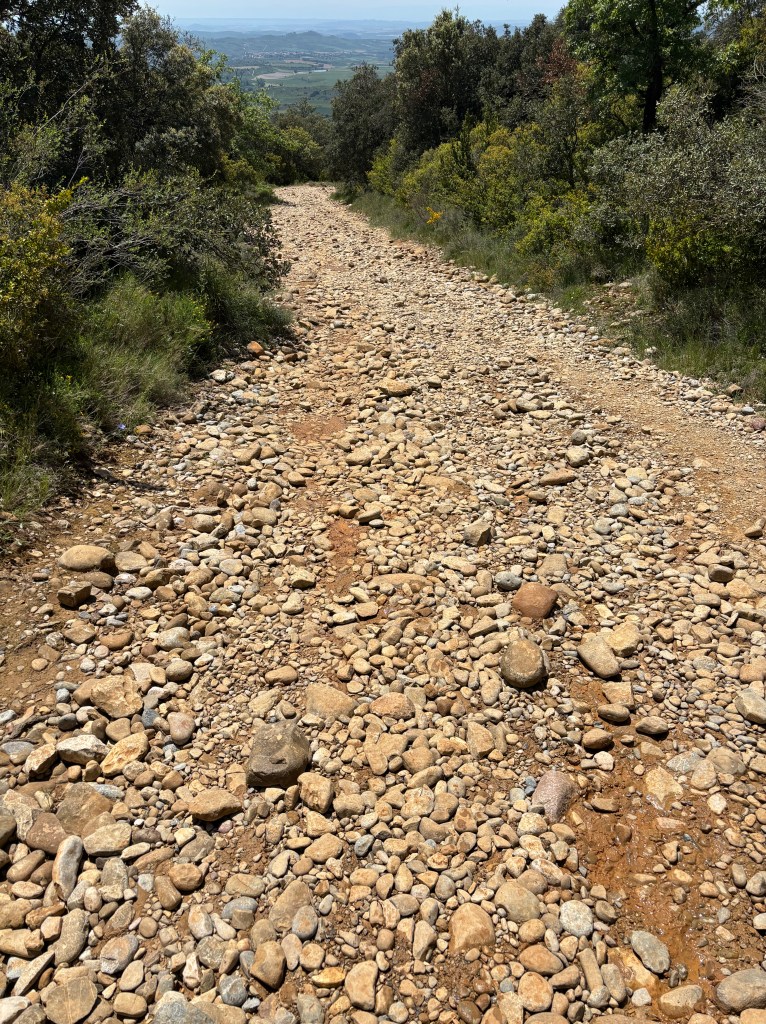
Then it was time to head down the mountain. There wasn’t really a trail, but more like a steep ski run of river rock.

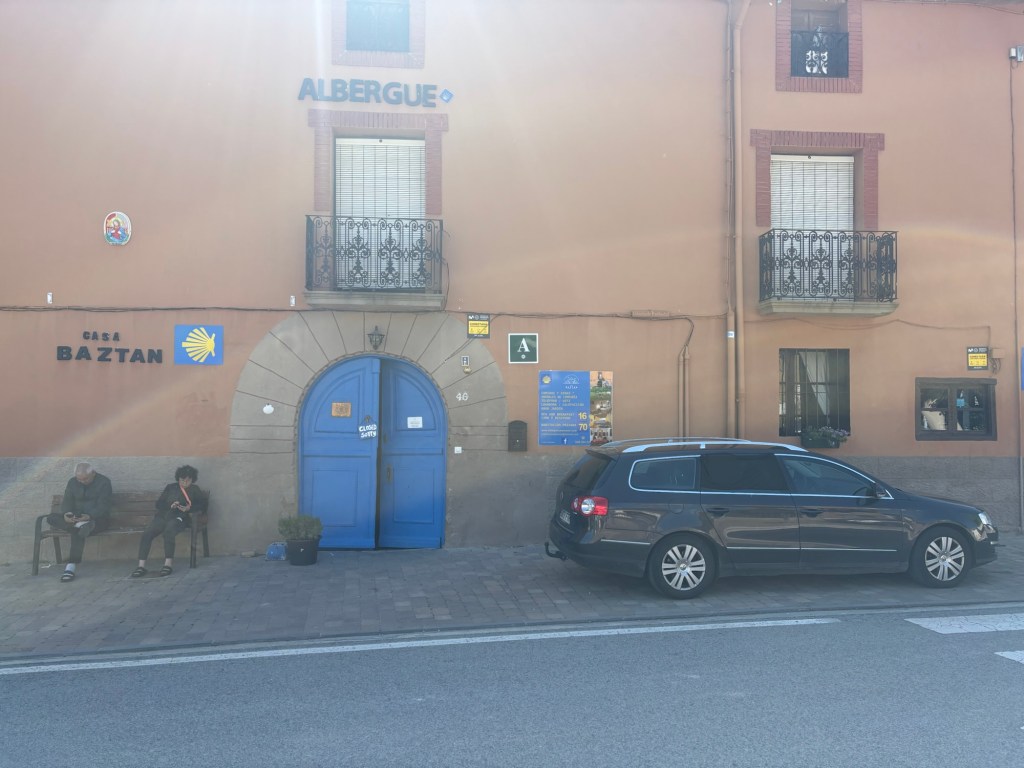
I’d found another use for my new trekking poles, it took a lot of concentration to maneuver down without slipping on the loose rocks, and it went on for over an hour. I was grateful to finally walk into Uterga and find my albergue, Casa Baztán. I had booked a bunk bed, but they had a private room open, and I gladly upgraded.

It was a shabby chic kind of albergue in an old stone house, probably from the 18th century. The host and his young family lived upstairs and there was a large bunk room, a dining room, and a big garden out back with chairs snd clotheslines.

Casa Baztán in Uterga

Notice the stone floor, river rock set on edge in decorative patterns. Very tough on bare feet!

The private room turned out to be on the second floor and had access to a bath down the hall. When I put my pack down n the bed I realized that the only access to another private room was through my private room.

“Private” room
Shabby chic

It was fine, actually. It turned out that I knew the couple in the adjoining room! They had stayed next to me at the hotel in Pamplona, Dick and Sue, from Phoenix.

After a shower and setting up my beloved sleeping bag for the first time, I ventured across the lane for a snack at the other albergue. It was completely opposite in every way, super modern and minimalist with an outdoor terrace.

I went back over and hung out in the backyard for a bit before dinner. I was tired after the big ascent and descent earlier, but I felt pretty good after a rest. Dick and Sue had taken a taxi out of Pamplona, saving them 5k on their first day. That would’ve been the prudent thing to do but I wanted to walk out of Pamplona for the full start of the Camino experience.

Dinner was served in the dining room, and was fresh fried fish or chicken, salad and chips plus vino tinto, and an ice cream bar. It all tasted great after walking that far. It was 12€ on top of the 30€ for the private room. The company was fun, a Dutch guy, Dick and Sue, a couple of Germans.

I could feel myself stiffening up so I went to bed fairly early and read for awhile. I was excited about walking to Eunate in the morning. The twin bed was comfortable and I was enjoying my Camino sleeping bag.

I woke up in the night around 3 am and felt reluctant to get out of bed and find my way down the tile stairs to the bathroom. Just then the door to the adjoining room opened and Sue walked out with a flashlight. Good timing. We walked down to the bathroom together.

In the morning I was going to have breakfast with Dick and Sue but the host directed me into an alcove set for breakfast in another room. It was like a small sitting room with a wood stove and an oversized couch. I asked him in Spanish what it was like in the winter here, and was the house in his family a long time? Yes it’s been in their family over 100 years. He seemed to like engaging with me in Spanish, and he liked running an albergue.

They’re closed in the winter and he said it’s very quiet. It’s different than a city he said. But he can go to Pamplona very easily. (Of course, you don’t need to scale the Alto de Perdón on foot!) I told him about my grandchildren and living in the Bay Area. It was the first time I’d felt fairly confident speaking that much in Spanish. It’s so much fun when it goes well.

I said that I preferred the pueblos on the Camino, and he seemed touched by that. Or maybe he was surprised that I knew the word Pueblo! He said, “it’s a pleasure to meet you,” and kissed my hand! It was sincere, not creepy.

In the entry hall I struck up a conversation with the two guys from Hong Kong as we put boots on, and our packs, and they walked out with me, and we all took pictures with the host (I wish I remembered his name).

I walked with the two nice guys from Hong Kong until it was time for me to peel off to go to Eunate. They said that the host had been super accommodating and let them cook their own dinner in the albergue kitchen. We talked about globalization and China and the US, all sorts of things, very fun. We said, “Buen Camino,” and I took the toad to Eunate. I felt quite blessed.

Categories: Camino de Santiago | Leave a comment

Pamplona to Uterga, 17.3k

I left my hotel at 7:00 and started walking. Yes, I was one of those irritating people using their poles on the pavement. I found the Camino shells in the street and slowly headed out of old town, through the shiny apartment area, green parks, University of Navarra, and new suburbs. I was once again in the river of pilgrims. Everyone said Buen Camino as they passed.

My first stop was at Cizur Menor, a village turned suburb, up the first hill, for a much needed cafe con leche and a slice of tortilla. I shared a table with a delightful mother and daughter from the Midwest. Then it was as time to walk again, and we entered the countryside. The sun warmed as the trail steepened. Up, up, up we went toward the Alto de Perdón at the top of the ridge with its spine of windmills.

Mud. There were sections of the trail underwater from the recent rains, and some low points were just muddy. That’s where poles are so valuable. But it’s tricky sometimes to keep your footing. In one spot pilgrims had walked on tufts of grass way off to the side of a muddy spot, and I followed their lead but it was jelly like underneath. The boots got a good coating of mud.


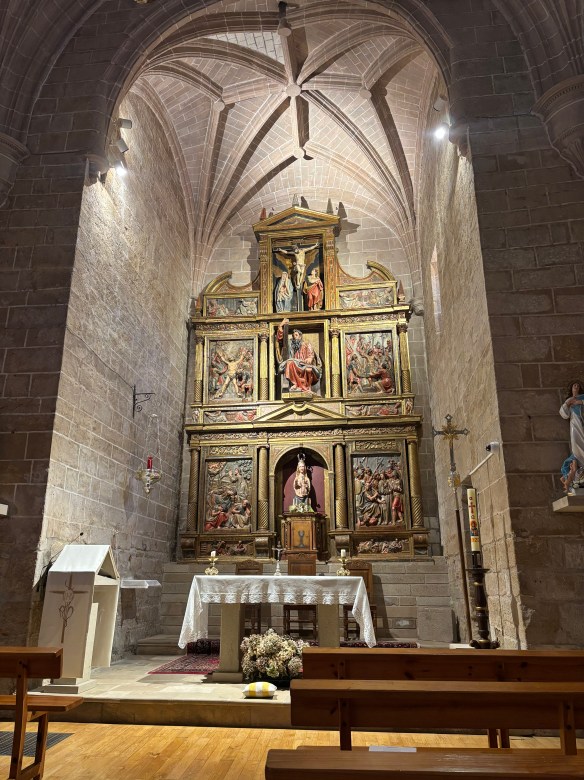
The next stop was Zariquigui, a village perched on the hillside, with an exquisite little church dedicated to San Andres. I stopped in to see it and enjoy the coolness inside.

After a banana and more water, it was time to get going. The trail went straight up the hill. It was tough, I had to stop a lot, but kept going, navigating through muddy patches. I made a point of looking back to see how far I’d come; Pamplona was getting smaller and smaller.

My poles were good for more than mud. On the last steep bit I found landed them to help pull me up the path.

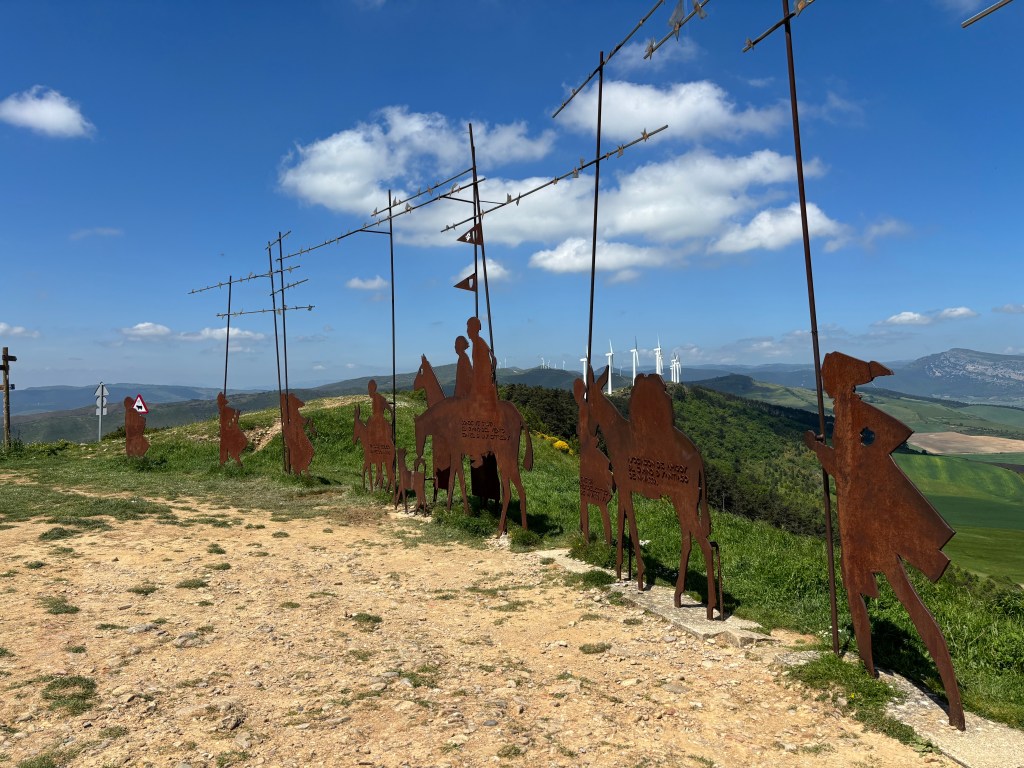
Finally, the famous cut-out sculpture, with silhouettes of medieval pilgrims, came into view. About 25-30 pilgrims were resting and taking pictures of themselves with the sculpture. I took off my boots and socks and had a chat with an Australian couple. It felt great to be at the top, but I knew there wad demanding terrain going down. It felt good to take a minute and savor it.

Categories: Camino de Santiago, Return to Camino | Tags: , , , , , , | 1 Comment

A little pre-Camino Magic

“The Camino Provides,” and “Camino Magic,” are terms that get thrown around a lot. In my experience they’re both true; I’ve found what I needed on the Camino, and received many more unexpected blessings. This time I experienced both here in Pamplona before I even started walking.

About ten years ago I lent some of my Camino books to a Nancy Reynolds, a fellow pilgrim I met on Facebook. We got together for coffee several times, and later, when I was Interim at St. Anne’s, Fremont, she came down with a friend to attend church on a Sunday and sit in on my presentation on the Camino.

At that point, Nancy already had a long association with the Camino. Then she started a company called “The Camino Experience,” where she serves as a coach and guide for groups of pilgrims making their first Camino. She meets them in St. Jean Pied-de-Port, builds community among the group, and helps them start over the Pyrenees, and on through Pamplona, where they all stay at the same Pension. She’s a wonderful resource.

I kept up with Nancy online and I was thrilled when I discovered her podcast, “You on the Camino.” It’s so good! She breaks down how to prepare for a Camino in a clear, step by step process, and poses great questions. She also interviews people preparing to walk and those who’ve returned.
That reflection piece is important and the need for it is underestimated. The Camino is a transformative journey that can continue to transform us if we listen to our experience and incorporate what we’ve learned into our life after the Camino.

As I was prepping for this trip I checked out Nancy’s “Camino Experience” website and saw that she and I would overlap in Pamplona. So I reached out and we made plans to reconnect while we were both here.

Yesterday we met for a delicious, long lunch at a restaurant where the Camino enters Pamplona. It was meaningful to talk with her about my pilgrimage as well as her work on the Camino with pilgrims. It was so much fun, we did it again today!

We agreed that the Camino is all about connection, transformation, and…Camino Magic.

If you’re interested in walking the Camino, be sure to check out Nancy’s podcast, “You on the Camino” wherever you get your podcasts. You can find the link to her company “The Camino Experience” on the homepage of the blog.


Categories: Camino de Santiago, Conversations on the Camino, Pilgrimage, Sharing the Camino, Spiritual Growth | Tags: , , , , | Leave a comment

Themes of this Camino, an evolving list

A very welcome sight last night after 18 hours of travel from San Francisco

I’m taking a slow morning here in Pamplona, just had a carb rich breakfast after about five hours of sleep and pretty much zero the night before on the plane.

Yesterday’s journey was really long: twelve hour flight to Madrid plus six hours on the bus (with a change in Soria) to Pamplona.

I didn’t realize how worried I was about catching the bus at the airport in time, and then getting into my hotel which had a code and a series of lockboxes to check in after hours.

That tendency to worry and go toward the negative sneaks up on me. Last week and yesterday I was really feeling the pressure-trip jitters. I was pleasantly surprised when all the transition points yesterday went smoothly.

But that underlying worry does steal my joy.

Here’s the first theme emerging for this pilgrimage. How can I be more self-aware and let go of that anxiety about uncertainty? It’s nothing new. I know I can handle wrinkly travel. I want to hold life more lightly and enjoy it more.

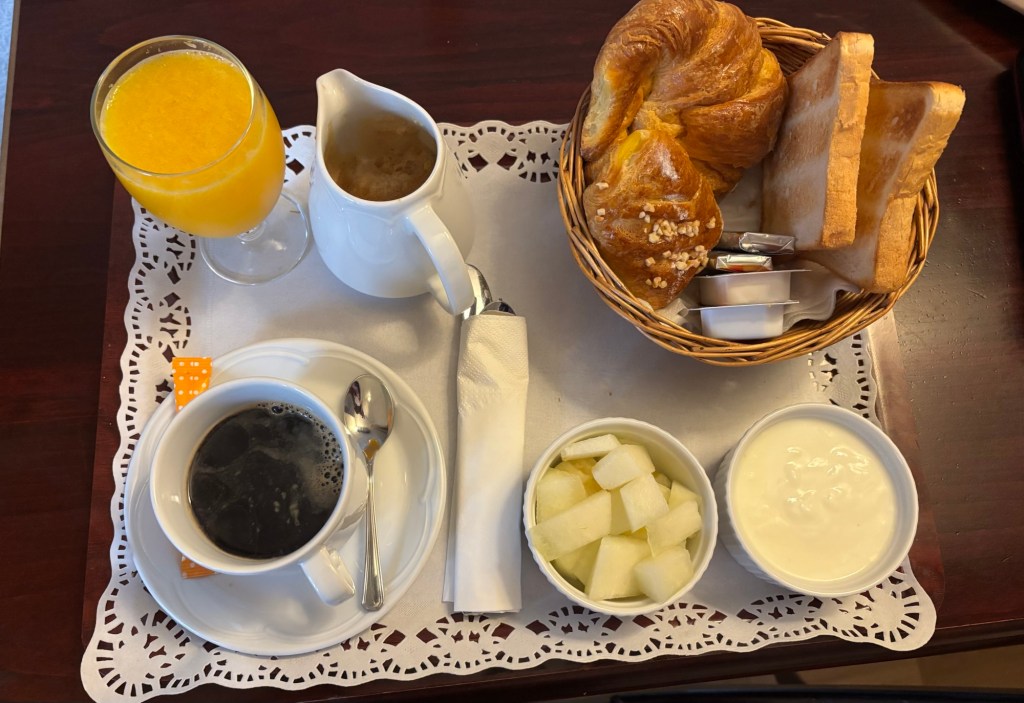
This morning I’m giving thanks for a smooth journey and the blessing of a Spanish breakfast, complete with Zuma de Naranja.

Delicious breakfast at Hostal Navarra
Categories: Camino de Santiago | 2 Comments

Planes, buses, time zones, joy

I’ve been planing this Camino since January. I think that diving into the details helped me get through the first 100 days of…you know what.

Today, embarkation day finally arrived. And just in the nick of time because I was driving myself crazy trying to pack, and keep my backpack a reasonable weight. One thing I’m noticing is that my last Camino was ten years ago, and things change. More necessities are needed. I finally made a deal with myself that I’ll use the bag service to lighten my pack.

I knew that I’d probably see some pilgrims at the gate and I wasn’t disappointed. A group of three women talked to me when they saw the shell on my pack. Two were walking from Sarria, and one from St. Jean. Later as we were disembarking, two other women said they too were walking from Sarria!

One unpleasant sign of the times: there were ICE officers stationed on the jetway as we boarded.

The flight to Madrid on Iberia was long, but fairly easy and I had an empty seat next to me. It was fun to have everything in Spanish and to be able to understand more than last time. Thanks, Duolingo!

I’m always in awe of European airports. MAD (Madrid) is huge, and has the best signage I’ve ever seen, and also has airport info desks with real live humans to answer your questions if needed.

Baggage claim at MAD

Of course I’ve been worrying about making my bus connection to Pamplona, which left an hour after I landed. It was a long walk, and train ride between terminals, through passport control, and another 10 minute walk to the Inter-City bus station by Terminal 4, but I made it with plenty of time to spare.

Buses in Spain are big, shiny, and very reasonable. It’s also convenient to go straight from the airport instead of going into central Madrid for a train.

Now I’m on the first leg of the bus trip, cruising through the countryside.

Fluffy white clouds en route to Pamplona

Buen Camino!

Categories: Camino de Santiago | Tags: , | 2 Comments

Blessing Shells (and Pilgrims) for the American Pilgrims on the Camino, Northern California Chapter

My remarks and blessing at the annual Shell Ceremony, March 1, 2025:

Being a pilgrim on the Camino means we go on pilgrimage.  Pilgrimage can mean different things to different people:  it can be the traditional religious pilgrimage to Santiago to visit the relics of St. James; it can be a spiritual journey where we challenge ourselves and live in the moment; it can be an adventure we feel called to take on. It can be a physical challenge.  There’s usually some kind of challenge involved.

Being a pilgrim means that we’ve felt a call to go out of our comfort zone and explore something beyond ourselves, and usually to explore inwardly as well.

The author Phil Costaneau writes in “The Art of Pilgrimage” that pilgrimage is about making travel sacred. Those of you who are walking this year, I encourage you to ask yourself, “Why am I walking?” and let that question live in your heart and listen to what comes up for you as you walk. 

The most recent issue of La Concha, the magazine of American Pilgrims on the Camino,  has reflections on “Keeping Time,” by pilgrims who share their experience of being on pilgrimage as a way to mark transitions or other significant events in their lives. That was true for me.

I walked the Camino Frances for the first time in 2013 after I left my position at a church in Menlo Park.  I was turning 55 and I saw an opening of time to walk the Camino.  I wanted to discern what was next.  Our kids were almost done with college.  I was also ready for a grand adventure. 

In June of 2013 Hale and I took a driving vacation in France that ended in SJPP.  It was like being dropped off at college.  We said goodbye at the Puerto de España, on the Camino just outside of St. Jean Pied de Port, and he drove off to Bordeaux and flew home. 

Suddenly, I was traveling alone.  For about a few uphill hours, I felt on my own…because I stopped at Orisson for the night and found a community of pilgrims.  I remain friends with several pilgrims I met at that first dinner. We just met up with Monika in Vienna last October. 

When you step onto the Camino you enter the stream of pilgrims. You’ve entered a community, and, like in life, you also walk your own journey.

The Camino taught me the hard way that we each have our own pace.

My ankle said “enough” in San Juan de Ortega after too many days of walking too far, too fast.  I had to cut my Camino short and go home hobbling. 

But I was fortunate to return in October and make it to Santiago.  I had a new sense of purpose, to walk my own Camino.  I discovered a “flow state” within myself, of being alive in body, mind and spirit. 

As a person of faith, I felt the presence of God along the Camino in many ways:  in my fellow pilgrims, in the beauty of Spain, and the Spanish people; the history, the art, the culture, the food; the feeling that we are walking the path that pilgrims like us have walked for over 1,000 years. 

There is a definite sense of spiritual energy along the Way, I hope you feel it, too.  The Camino invites us to BE ALIVE and BE THANKFUL for life.

I’m excited to be returning to walk a portion of the Camino Frances in May, from Pamplona to Burgos.  This time around I want to give thanks for becoming a grandmother.  I want to give thanks for the lives of my parents who lived long lives and died five years ago. I’ve been studying Spanish and I’m looking forward to speaking Spanish with the wonderful people of Spain hosting us along the Camino. 

I look forward to that rhythm of walking poles and footsteps that becomes a walking prayer.  People have asked me to pray for our country. I will pray for our country, and the world in which our grandchildren and all our children are growing up in.

These days you can find me preparing to walk the Camino.  I’m walking the streets of Alameda, around Lafayette Reservoir, Lake Merritt, and in Joaquin Miller park. 

And I hope to see some of you fellow pilgrims on the Camino.

Blessing of the Shells

We gather today from all across Northern California

To share a meal, share our stories, our hopes and dreams

To build a community of pilgrims

To support our fellow pilgrims as they prepare to walk

The many routes to Santiago.

Now, let us gather all the love from this group,

the love of the spirit of the Camino

And the thread of love that connects all humanity

To bless these shells,

symbols and talismans of the pilgrimage. 

May these shells identify each of you as a pilgrim on the Way

May they protect you and keep you safe

May they always remind you

That you are walking the ancient way of St. James.

Buen Camino and Amen.

Categories: Blessings, Pilgrimage | Tags: , , , , , , , , | 2 Comments

My last day of walking the Camino: The Long Story

Setting out on my last day walking the Camino from Mansilla de las Mulas.

Setting out on my last day walking the Camino from Mansilla de las Mulas.

I walked the Camino Frances in three trips. Camino 1.0 was from St. Jean-Pied-de-Port to Burgos, in June, 2013. Camino 2.0 was from Leon to Santiago, in October 2013. That left the section in the middle from Burgos to Leon for my Camino 3.0, in April, 2015.

That’s the short story of why I was walking into Leon on April 19th, 2015.

After 10 days of walking from Burgos,  I was in Mansillas de las Mulas, only 18 kilometers away from Leon. Here’s the long story of what that day was like.

The night before I walked into Leon I was seriously thinking of taking a taxi because one of my ankles was hurting and when I talked with my husband on the phone, it seemed like the logical thing to do. The walk into Leon was known to be tedious, and lots of pilgrims bussed through it. When I began my second Camino, in October 2013, from Leon, I took a taxi out past the suburbs, and I didn’t regret it.

But when I got up the next morning to head out from Mansilla de los Mulas towards Leon, I felt I needed to walk at least part of the way. I decided I’d see how I felt as the day unfolded.

I had mixed feelings about finishing my Camino 3.0, and finishing the whole Camino in general.

Sign just outside Mansilla de las Mulas

Sign just outside Mansilla de las Mulas

The April trip was empowering. I totally enjoyed the walking, the solitude, and the conversations along the way. Every day I felt physically challenged and spiritually fulfilled. The Camino was as magical as it had been before. Each of my three trips had its own flavor, its own season (summer, fall, and now spring) and each trip took me deeper into the spirituality of walking solo. Camino 3.0, across the Meseta, had been more contemplative than the other two trips, more like a retreat.

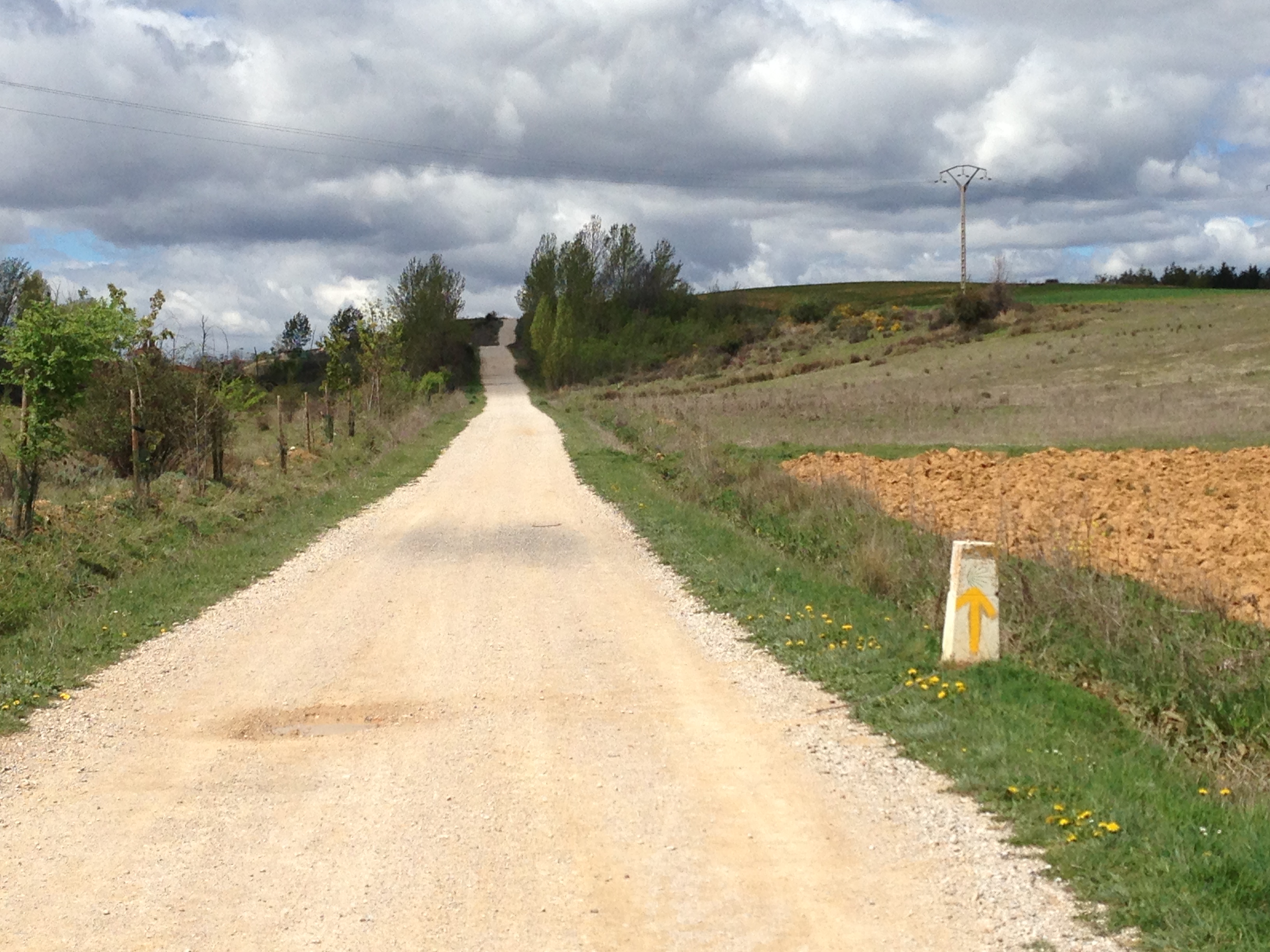
There was something very attractive about the sureness of following the yellow arrows on the Camino.  But now the adventure was about to end, and I found myself feeling of sad and wrestling with the feelings of “what’s next?”  I didn’t want Camino 3.0 to end.

When I was a kid I had the habit of saying, “Oh, it doesn’t matter.” My Mom used to respond with, “No, everything matters,” which would make me angry. I realize now that I used to say “It doesn’t matter,”  when I couldn’t express my feelings very well, and that my Mom said “No, everything matters,” to help me.  But she didn’t quite know how to get me to open up and share what was going on inside.  As an adult, and a Mom myself, I realized how frustrating it must have been for her to try and help me process my feelings.

I still struggle with that feeling of emotional ambiguity as an adult, and I was in one of those frustrating “Oh it doesn’t matter” kind of moods as I left Mansilla de las Mulas, and I spent a lot of the day debating whether I should call a taxi or not.

Even on the last day of walking, the Camino had something to teach me.

In the morning, I prayed for strong ankles, and to be open to what the Spirit wanted me to learn. I ate a late breakfast at my beautiful little hotel in Mansilla de las Mulas with the group of Irish women walking together I’d met the night before.

Javier saying

Javier saying “Buen Camino!”

Javier, the owner of the hotel, said “Buen Camino,” and waved me onto the Camino.   He was one of the many gems of hospitality I’d met along the Way.

The 18 kilometers to Leon were not scenic, or beautifully empty, like the Meseta. But there were memorable moments.

Hill fort where the ancient Asturians lost their battle against the Romans.

Hill fort where the ancient Asturians lost their last battle with the Romans.

There was the hill fort at kilometer 3 where the ancient Asturians lost their struggle with the Romans. Right in front of it was a gas station.  I love the juxtapositions of eras along the Camino!  There was a long, medieval bridge at kilometer 6 that was still used by cars. A modern pedestrian bridge had been built alongside it for the pilgrim traffic.

The 20 span Puente Ingente over rio Moro

The 20 span Puente Ingente over rio Moro

I ducked into a village church in Villamorros in the middle of a Mass, and was happy to see a young girl assisting the priest at the altar.  At about kilometer 9, my left ankle began to hurt again. It was midday, and it was hot for April. The Camino was shunted under highway overpasses, and ran next to junkyards.

The Camino meets billboards for the Macy's of Spain

The Camino meets billboards for the Macy’s of Spain

Junkyard Dog outside of Leon

Junkyard Dog outside of Leon

That was the low point.  For the first time since I’d left home, I wondered about how safe it was to be walking alone. Why was I doing this again?

The guidebook said there was an albergue and café just up ahead in Arcahueja. Maybe that’s where I would call my taxi.  When I got to the cafe, I found the five nice Irish women I’d met in Mansilla hanging out. They looked pretty out of sorts, too. We said, “hello” and complained a little about the heat.

Cafe/Bar La Torre in Arcahueja

Cafe/Bar La Torre in Arcahueja

I asked the bartender how far it was to Leon. He said it was only 11K, and “there’s a beautiful view of the city just up ahead.” (I’m sure he tells everyone that!) I asked if a bus stopped in the village or if they had a taxi. “No” he said. Hmmm.

I ordered a slice of tortilla, two deviled eggs, and a café con leche. What should I do? I felt bone tired and was so tempted to call a taxi. My food arrived, and I realized I was ravenous.

Once the protein in the eggs and the tortilla  kicked in, it became clear to me that I really needed to walk the entire way into Leon, and make Camino 3.0 a Cathedral to Cathedral affair.  As my Mom would have said, “it mattered.”

Once I finally got clarity, I felt the need for some encouragement to make it into Leon.

I had an idea. I turned on my phone and checked into the American Pilgrims on the Camino Facebook page. It was 4 a.m. in California, and 7:00 a.m. on the East Coast. Someone must be up and reading the page. I posted that I was 11 K out of Leon and was tempted to take a taxi, and needed some support. I posted it on this blog, too.

Immediately, waves of energy started rolling into that little café in Arcahueja through my iPhone! “You can do it! Don’t quit! Feel the burn!” Over a hundred people responded, cheered me on, and sent prayers via the APOC Facebook page. My brother-in-law in Washington, D.C. saw the post on the blog and gave me a big PUSH.

The Camino taught me—again—that sharing my feelings and asking for support is ok. Feeling vulnerable is ok. It’s usually in those moments when God reaches through our stoic armor and touches us.  My unspoken prayers during my morning’s walk were answered.

I said “Buen Camino” to the Irish crew and headed back out on the Camino, now excited to continue. The guy behind the bar had exaggerated just a little though; it was a long time before I saw the view of Leon.

The last hill before I could see the city of Leon

The last hill before I could see the city of Leon

I passed big box stores, and auto dealerships, and medieval churches with storks nesting on top of them.

The funny thing was, my ankle stopped hurting completely. It was amazing.  I picked up the pace.  There seemed to be very few other pilgrims walking that afternoon.

The Camino crossed the Autovia (freeway) on a dedicated pedestrian bridge, and the amount of concrete and apartment buildings reminded me of my long walk into Santiago in the rain, in October of 2013. But weather was good, and I was very thankful.

Out in the distance I could see the Cathedral in Leon, with the snowy mountains behind it. How I wished I could keep walking on to Astorga and beyond. It was a new experience to know what was up ahead on the Camino. That’s when I knew that I had almost finished the whole Camino Frances.

Cathedral at last, but still a long ways off.

The Cathedral in view at last, but still a long ways off.

Walking from the bar in Arcahueja to the Cathedral took about two hours of brisk walking. I felt great, aligned in my purpose. The feelings of sadness about finishing were still there, but I didn’t blow them off by calling a taxi. I walked and felt sadness and joy, and was determined to finish strong.

Once past the newer parts of Leon, passing apartment blocks and crossing roundabouts, The Camino bridged a small stream and led me through the ancient city walls.

It continued into a tangle of medieval streets and spit me out on the grand avenue in front of the building designed by Gaudi. Suddenly, I knew where I was. The Cathedral was just up ahead. And then I was standing in front of it, looking up at its fantastic exterior.

Approaching the Cathedral

Approaching the Cathedral

It was nearly 4:00 p.m. on a Sunday afternoon, and the doors were closed for Siesta.

When the adrenalin subsided, the sad feelings welled up again. No one was there to celebrate my arrival, and I had a wave of homesickness. But Mary was there, up on her pedestal outside, by the locked doors, holding baby Jesus in her arms, and she was smiling.

Mary holding Christ

Mary holding Christ

Thank you for being there, Mary.

Mary greeted me, and sent me off to my hotel to check in and relax. I was grateful for the lessons I’d learned that day. I wasn’t really alone. The Spirit was with me, and I felt blessed by the wave of energy and love from my fellow Pilgrims back in the States that had swept me on, to finish Camino 3.0, and the entire Camino.  Amen.

Categories: April 2015, Camino de Santiago, Leon, Pilgrimage | Tags: , , , , , , , , | 9 Comments

Blog at WordPress.com.