Camino Guidebooks

Estella rest day

I woke up with the calming white noise sound of the river coming through the window. I saw a text that Hale at home wanted to chat. It was still last night for him. We agreed to talk in 45 minutes when everyone else in the room was up.

I got dressed and we had a good FaceTime chat, me well-rested while he was yawning and ready for bed. It was good to see his face after almost a week apart.

Even though I’d done laundry in Obanos, my wardrobe is limited, so it was time for some laundry again.

European washing machine with international instructions
Scenic drying area

I decided to brave using the washing machine and tried to make sure it was cold water only since I have lots of merino wool socks and ropa interior. (It’s great by the way! Who knew wool underwear was comfortable!)

I drove myself a little crazy watching the lights go on next to what looked like symbol for hot water, but it all came out ok and I hung it up to dry on a rack in this scenic spot just outside the albergue.

Once that was done, it was time to enjoy my rest day in Estella. I walked down into town again and ran into Linda and Mark who I’d met in Cirauqui, walking through town on the Camino. They were skipping Estella and staying farther along. It was my favorite kind of Camino moment.

We shared contact info and they also shared some lambswool for my developing blister. Wearing my crocs was helping it settle down, but I was grateful for the gift.

We said our Buen Caminos, and I peeled off to see all the churches in Estella, which I’ve read about in my trusty guidebooks.

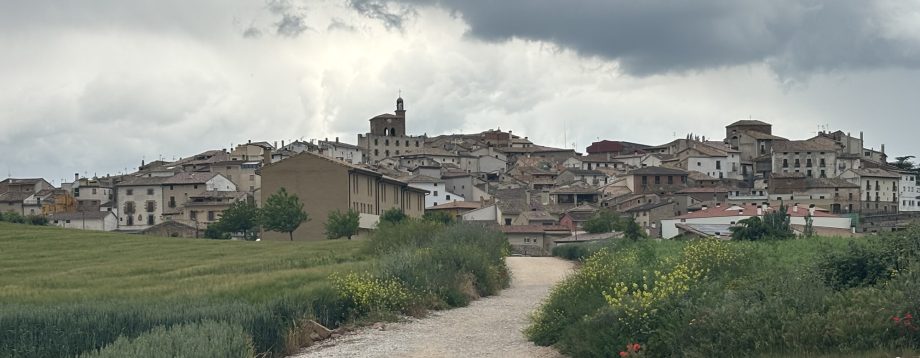
Estella is built into a gorge with rocky peaks all around the touch the edges of the old town. The way it was as organized around a river and hills reminded me of Cincinnati. All of the churches I wanted to see were built elevated way above street level. The first one was San Pedro de Rua.

San Pedro de Rua
St. James the Pilgrim

Another nice examples of Santiago the Pilgrim and a prayer to go with it. The cloister was unique, set into the hill.

After climbing all those stairs, I left the church at the top of the hill and noticed that the city had built a free-standing glass elevator. I took advantage of it since the prospect of going down all those stairs without a handrail and without my poles was stressing me out.

I walked across the river and into the heart of the medieval town to find Iglesia de San Miguel. It was also way up on a rocky crag.
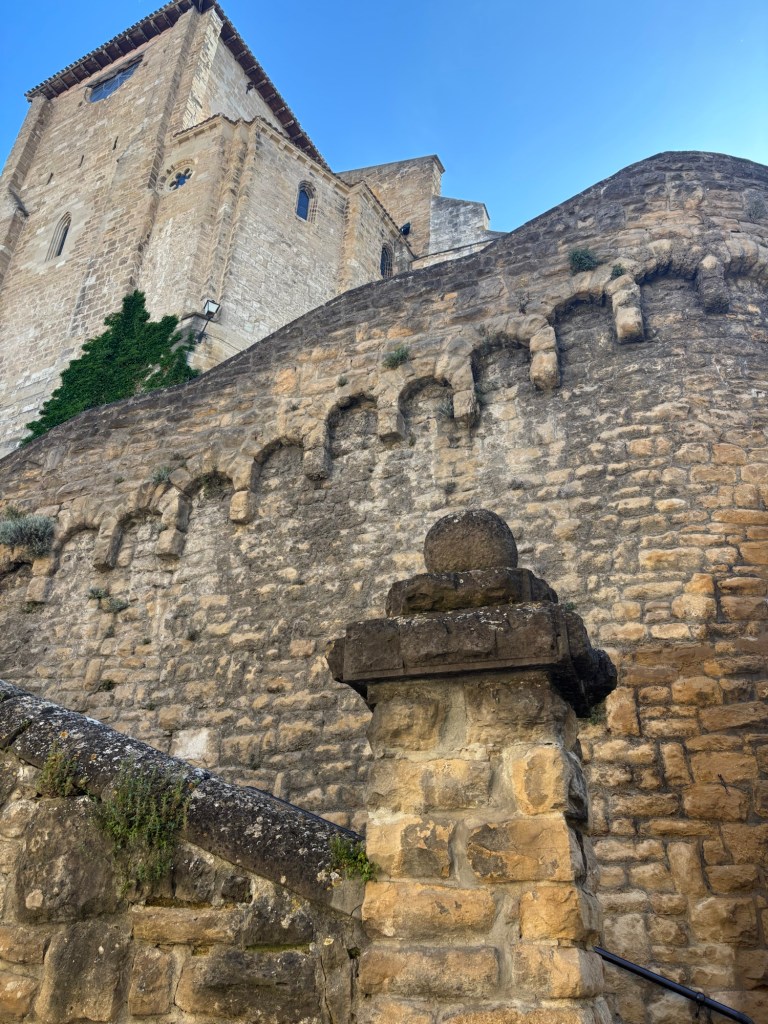
Stairs to Iglesia de San Miguel

Once up there, I found the best part: the art around the entry. Truly worth the climb!
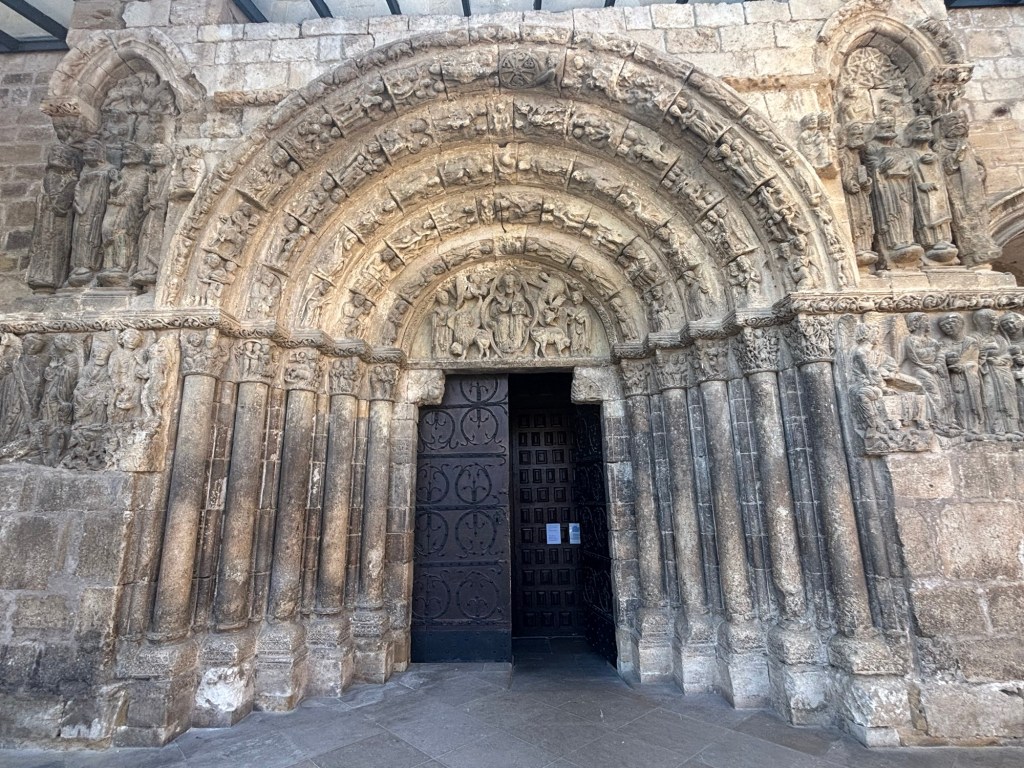
There were so many identifiable biblical scenes:

Mary and Elizabeth greeting each other
Animals greeting the baby Jesus in the manger
Mary Magdalene and women coming to the empty tomb at Easter
St. George and the Dragon

And there were some more unusual carvings, too.

What my guidebook says is a woman breastfeeding two snakes, a positive image in pre-Christian folklore but frowned upon after 12th century
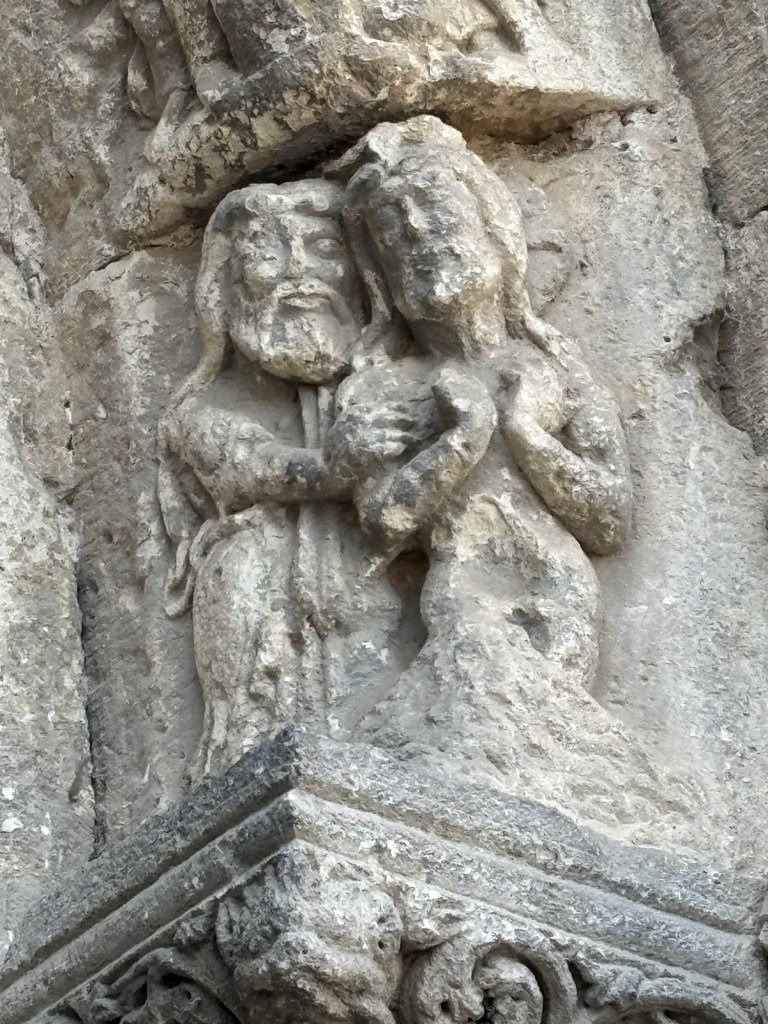
This looks like a man and a mermaid (symbol of temptation) to me
And a sweet, angelic thurifer

The church itself wasn’t that interesting on the inside. The terrace had another ancient olive tree growing out of the rock.

Olive Tree with shadows

After contemplating the entryway sculpture again, I wandered out into the street on the upside of the church to find some lunch.

I was noticing that Estella was quite a diverse town. I saw lots of women in headscarves, and I also ran across a tienda with Mexican products. I’d read that since the Middle Ages Estella was known for its Jewish, Muslim, and French population.

After a slice of tortilla for lunch, I ventured on to see the Basilica of Our Lady of Puy. The guidebook said it was on a hill overlooking the city and they weren’t kidding. About half way up, I thought, “why am I doing this?” It was like climbing Telegraph Hill in San Francisco, but on a hot day.

I sat on the side of the road and rested for a minute. What happened to my rest day? I was up to 10,000 steps already.

When I got to the top I found the basilica open. It was built in the 1950’s where a much older structure had disintegrated.

In 1085 shepherds reported seeing stars falling over the hill in front of the mouth of a cave. When they went inside, they found the statue of the Virgen there, in the cave. It’s a similar story to the Virgen in Nájera, one of my favorite spots on the Camino.

These Black Madonna stories fascinate me, so I had to see it.

No one was there so I had the place to myself. The people of Estella decided to honor their multi-faith heritage when the new structure was designed, so it has a Moorish feel and incorporates the symbol of Estella the Mudejar eight pointed star.

Ceiling of the Basilica Nuestra Señora de Puy

I’m confused whether this is the original statue because my excellent guidebook, The Moon Camino de Santiago by Beene Bahrain, says the original one is at the back of the church, but I didn’t see any statue there, just the one over the altar. She does seem to glow. She has the image of the moon under her feet much like Our Lady of Guadeloupe in Mexico.
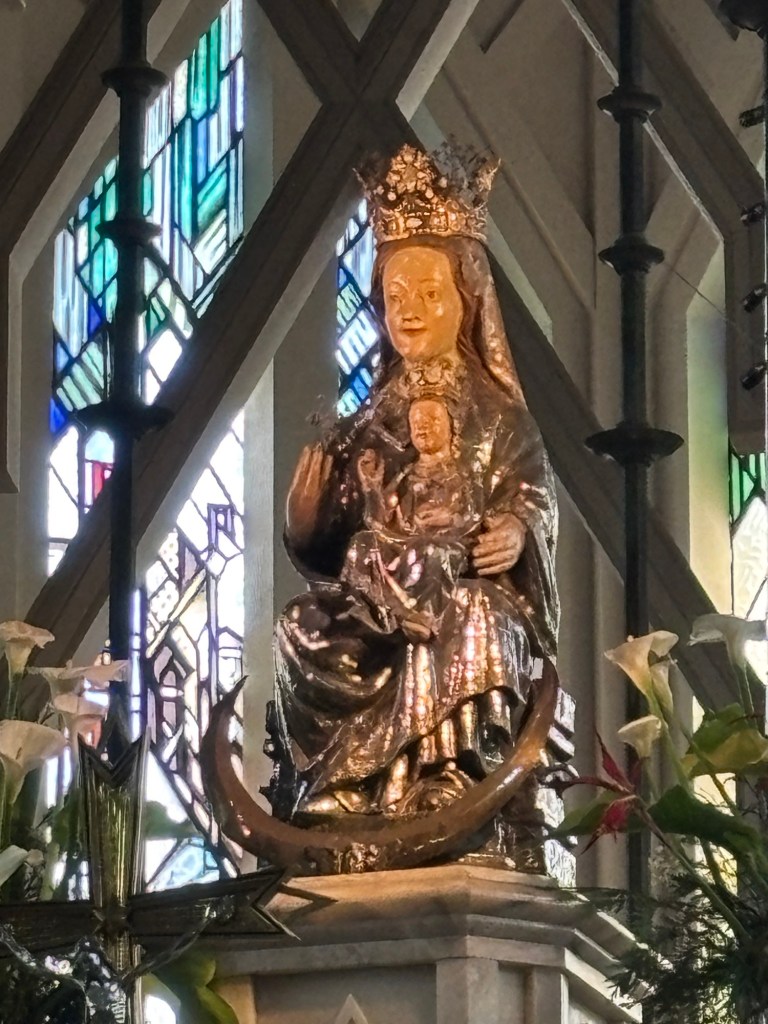
Nuestra Señora del Puy

My so called rest day continued with a careful walk down the hill just as hundreds of high school students exited the two secondary schools which are also up there on the hill. I returned to the albergue and met the new women in the room, a very fastidious woman from Korea, and a Spanish woman named Toni. I took a siesta nap, and headed out for an early dinner.

Estella was a good place for a rest day, though I did miss walking. When I set up my itinerary I thought I would be more tired than I was. But I enjoyed seeing more of Estella.

With newly clean clothes, I packed up for my next stop in the morning, Villamayor de Monjardin, about 12k up the road.
Categories: Camino de Santiago, Camino Guidebooks | Tags: , , , , | Leave a comment

Reflections on a Guidebook

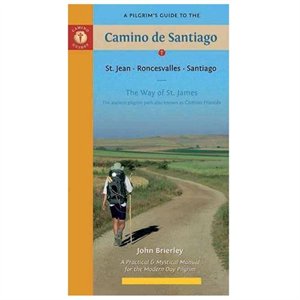
A Pilgrim's Guide to the Camino de Santiago by John Brierley

A Pilgrim’s Guide to the Camino de Santiago, A Practical & Mystical Manual for the Modern Pilgrim by John Brierley

If you learned to drive before the Internet, like I did, you probably spent a lot of time with the DMV Handbook learning the rules of the road. I’m sure I spent just as much time with John Brierley’s Guidebook, “A Pilgrim’s Guide to the Camino de Santiago” as I prepared to walk the Camino. And then I studied it everyday I was on the Camino. My copy is dog-eared and water-stained. But I love it. Unlike a lot of guidebooks, this one has a definite voice, of John Brierley, who’s very male, Anglo, fit, and for some reason, doesn’t much like pilgrims to spend time in cities along the Camino. After all the time I’ve spent with his book, I feel like I know the guy.

What I like most about Brierley is his interest in the “Inner Path” of the Way of St. James. The subtitle of the guidebook is, “A Practical & Mystical Manual for the Modern Day Pilgrim.” He includes a self-assessment with questions like, “How do you differentiate pilgrimage from a long distance walk? “What do you see as the primary purpose of your life? Are you working consciously towards fulfilling that purpose?”

Those are very big questions for a travel guidebook. But the Camino is a very big walk. Brierley keeps reminding you that you’re on a Pilgrimage. Even on the days when you wonder why the heck you are walking for in the rain for five hours.

Brierley balances these big, philosophical questions with a ton of practical details. He breaks the Camino into thirty-three stages. Each stage is meticulously researched and has its own map and contour guide so you can see what kind of elevation to expect from day to day. The listings of amenities, down to individual villages, are very accurate. Access to this kind of information in English was priceless to a tired Pilgrim.

Each stage in the guidebook begins with a quote. Some are familiar, like: “Be the change you want to see in the world,” Mahatma Ghandi, and “Practice random acts of loving kindness and acts of senseless beauty.” Some of them sang to me as I walked: “Worrying is praying for what you don’t want,” and “Yesterday is history, tomorrow is a mystery and today a gift—that is why it is called the present.”

He also includes “Personal reflections” from Anonymous Pilgrims. When I read them before walking the Camino they seemed sentimental or even surreal. But once I was a Pilgrim myself, they made much more sense, and now they remind me of what it’s like to be in the Pilgrim state of mind. You’re often bone-tired, sore, and nursing an injury. You’re also full of joy, endorphins, and having the time of your life, all at the same time. Being a Pilgrim means entering an altered state of wonder.

In that altered state it’s easy to forget your physical limitations. Even though Brierley recommends taking it easy in the first few stages, and listening to your body, the fact that he’s chopped the Camino into 33 stages makes it seem like everyone should be able to walk 20-30 kilometers every day. His stages have become normative for American Pilgrims.

Beware! In your “regular life” you would never walk a half-marathon a day thirty days in a row. Even after training for the Camino, most people need more than the 2 rest days he recommends. It’s easy to overdo it, injure yourself, and have to stop, or even go home. That’s what happened to me in June, 2013.

When I returned in October of the same year, I cut Brierley’s stages in half—to 12-15 kilometers a day.

It opened up the Camino for me because I was no longer focusing on getting to a certain town at the end of each Brierley stage. I stopped whenever I wanted to. The journey became more about the journey than the destination. And that is what the Camino is all about.

As time went on, I found myself leaving my Brierley guide in its ziplock bag, and just enjoying where I was on the Camino. That’s what the Camino is about, too. The maps began to seem unnecessary. The yellow arrows marking the Camino were enough.

Yellow Arrow along the Camino

Yellow Arrow along the Camino

Perhaps the best thing about the Brierley guide was that it helped me to have more faith in myself as a solo traveler, and to claim my own Camino.

I’ve sometimes wished that Life had a guidebook that gave Brierley-like advice: “at this point the trail splits into three and you have to choose your level of difficulty”, or “here’s the contour guide for young adulthood, and middle age.”

But life is more unpredictable than that. We sometimes find ourselves on the most difficult path that we would have never chosen. Or have long phases of sameness, like the section on the Camino called the Meseta.

Who’s with you on the journey makes all the difference. Even at his most mystical, John Brierley never mentioned this: Jesus kept showing up to walk with me, through my fellow Pilgrims.

Dear Pilgrim, I hope you enjoy Brierley’s guidebook as much as I have. It points you toward the good stuff. But remember to take your eyes off the guidebook and live in the moment. It’s even better than what Brierley describes.

Categories: Book Reviews, Camino Guidebooks, Camino Logistics, Reflections | Tags: , , , , | 2 Comments

Blog at WordPress.com.