Pilgrimage

Walking into Burgos, 2.5k plus 9k taxi ride and 8.2k

The next morning in Ages, the lobby of the Albergue was stuffed with luggage for Jacotrans and the other services to pick up. Somehow, I ended up being one of the last people to leave. My boots were the last ones on the rack.

Getting started at 8:30, late for pilgrims

Lila, the Danish woman and I started out walking together. It was a glorious morning with sun, blue sky, and the Camino took us past charming half-timbered houses.

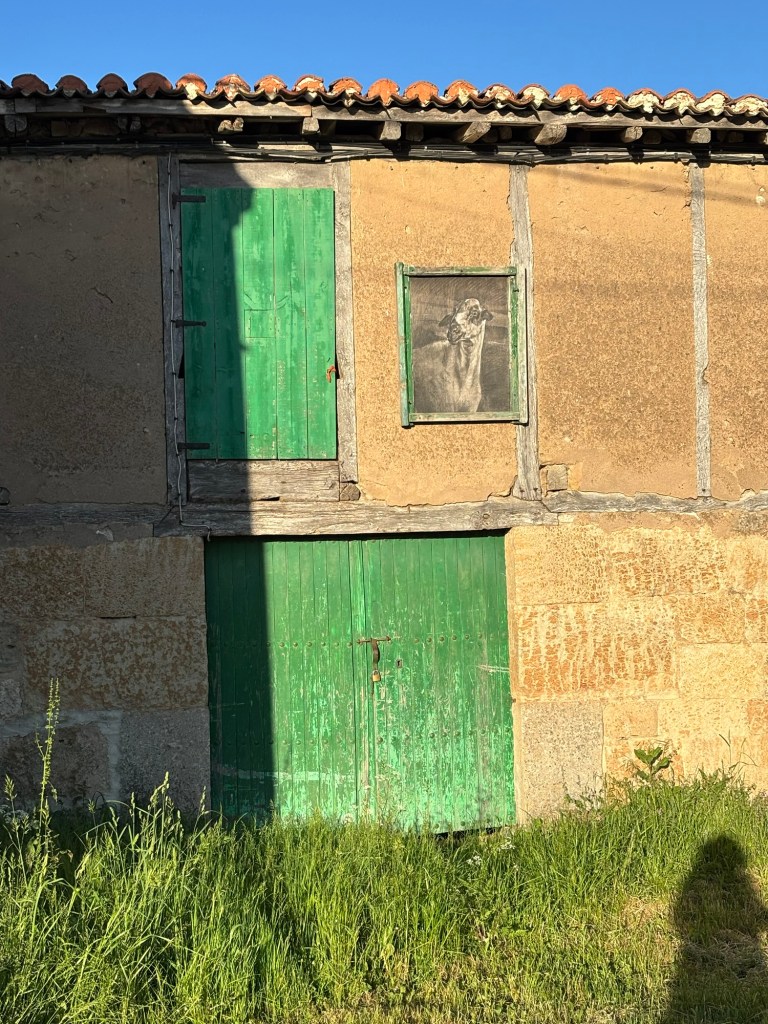
Half-timbered house in Ages

There was a circle of stones off to the left of the road, and I wanted to see what they were. They reminded me of the stones at the top of Alto de Perdon that were a Civil War monument. At that moment I realized that both Lila and I were both used to walking at our own pace, and I am a habitual reader of signs, plaques, and lover of views. I stop a lot. I sensed Lila was ready to make better time. I was also in search of coffee because I left Ages without having breakfast. When we got to the next village I said I was stopping for coffee and she said she could wait longer. We said, “Buen Camino,” and she walked ahead.

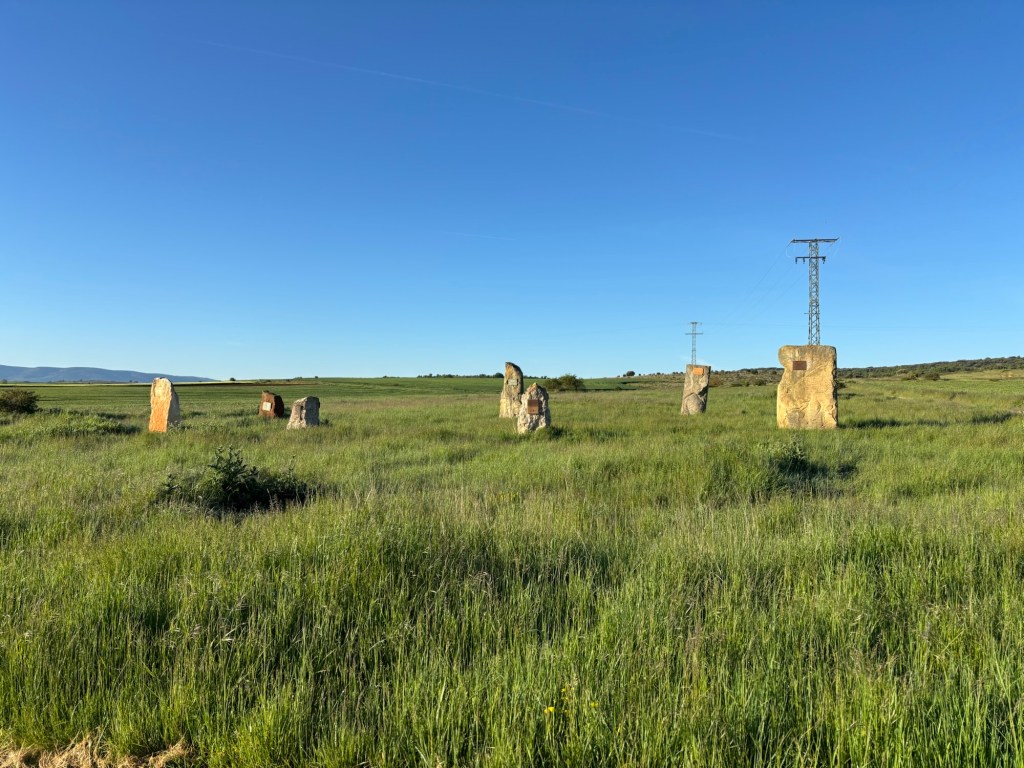
Circle of stones
Entering Atepuerca

My itinerary was getting a bit squished. I wanted to be in Burgos around 5:00 to meet Hale at the bus station, and I had 23k to walk. I also didn’t want to be thrashed when he arrived. Having walked into cities before, I knew how tough the kilometers on pavement could be on your feet. I wanted to walk into Burgos along the river but I wanted to avoid the next 10k or so through the industrial outskirts.

So, I asked the bar in Atapuerca to call for a taxi. I calculated that if I skipped to Costanones, I could pick up the river path and have a scenic 10k walk. I realized that we’d called for a taxi in 2013 at the same cafe, which felt a little like Deja-vu.

The taxi driver arrived and we sped off down the two lane road, then got on the motorway and then took several turns off it into roundabouts. As the crow flies it’s not that far from Burgos so the roads were built for suburban traffic.

The Camino’s approach into Burgos is complicated. There’s a path that follows the road, and two other paths that hug the beautiful shallow river that runs through Burgos. I definitely wanted to try one of those, but the description in the guidebook looked confusing. You know it’s confusing when the guidebook says, “Stop! Focus!”

Fortunately, my dashing taxi driver knew where to go. He let me out where an industrial park met the river path. I was immediately in a greenway, but the signage was somewhat lacking. There were yellow arrows every once in awhile but not many.

But it didn’t seem to matter because the river was on my right, and the path was well-defined. I saw two pilgrim up ahead of me, so I tried to keep them in sight.

Finding the river route into Burgos

It did seem like my days of walking had sped by too fast. In some ways I was just getting in the groove, and wouldn’t it be fun to keep going? At the same time, I was looking forward to seeing Hale and showing him beautiful Burgos.

So I strolled along taking my time and enjoying the river route. Whenever I stopped to recalibrate my route, a jogger would cry out, “Camino!” Pointing me the right way.

After awhile the path became paved, and then became a wide sidewalk along the river. There were lots of residents of all ages out strolling with friends, or getting exercise, or pushing elderly people in wheelchairs and babies in strollers. Every once in awhile there was access to the dirt path closer to the river and I took advantage of it, to walk under the weeping willow trees.

Elegant sycamores

I paused for awhile on a park bench and tried to gather my thoughts before entering town.

I didn’t have any grand summations on the last 12 days. I did feel a sense of gratitude for the time to walk and finding that sense of timelessness again along the Camino that felt grounding to me. Seeing the churches and art gave me joy. I love the human scale of the villages, the narrow streets. I love meeting people from all over the world, drawn to walk in a common direction.

I also felt grateful to be healthy and strong enough to walk the Camino again. My broken wrist, surgery, and osteoporosis diagnosis two years ago had made me anxious about doing another Camino. Was it such a good idea to wear a full-sized pack? I don’t know, but maybe it’s helped my spinal bone density numbers. I haven’t had any back issues. The only side effect of walking has been heat rash on longer stretches. And yeah, no blisters!

As I sat there I gave thanks for not falling, and for no injuries, and not getting sick. As always, I felt a deep sense of safety on the Camino, and a sense of faith in humanity. Trust. With all that’s happening in the US, I needed that. It’s been healing.

Gate into old Burgos

I crossed the river and passed through the old gate into central Burgos. It reminded me of the gate in Canterbury, but much bigger and in better shape. Once through the gate, the Cathedral appears, massive and towering at the same time. It’s one of my most favorite cathedrals, a work of art, full of art.
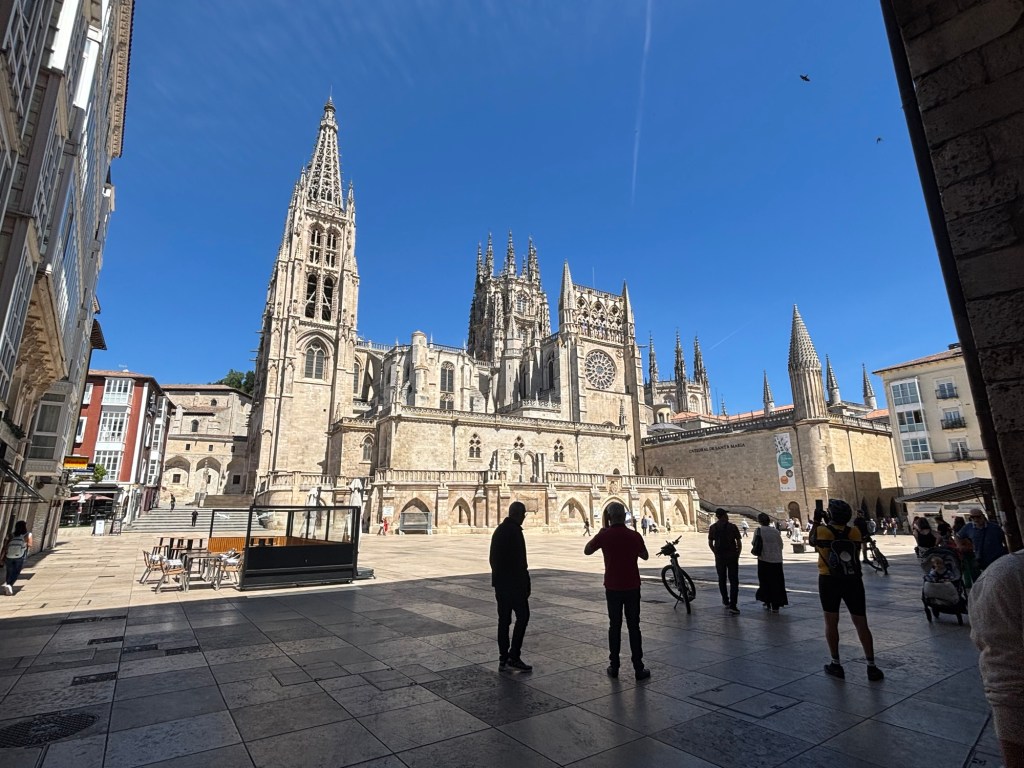
It felt a bit like coming home. This was the third time I’ve been there, and I remembered how to get around the old part of the city. Now it was time to find Hotel Notre y Londres and rest before meeting Hale at the bus station.

Categories: Camino de Santiago, Pilgrimage | Tags: , , , , , , | Leave a comment

Roads not taken, revisited: Eunate, 9.2k to Obanos

I fell in love with the Francés the first time I walked it twelve years ago. And I was walking fast, trying to keep up with the traditional stages, walking 20k+ a day. I remember thinking, “Wait, I want to see that!” But either I was moving too fast or I was just too tired to walk a couple extra kilometers off the Camino to see some of the places just off the Camino.

The ancient church of Santa Maria de Eunate was one of those places. I distinctly remember standing on the trail with my new Camino friend Monika at the crossroads for the road to Eunate, and her telling me I should take the detour. But I was way too tired to do an extra 3.5 K and back.

When I started planning this Pamplona to Burgos Camino, I wanted the freedom to take those roads I didn’t take before. I wanted to say yes to the detours. And I wanted to make sure to see Eunate.

On Sunday I had my chance to say yes. I left the cute albergue in Uterga at 8:00 and walked out of town with two young guys from Hong Kong then said goodbye to them where the detour to Eunate branched off.

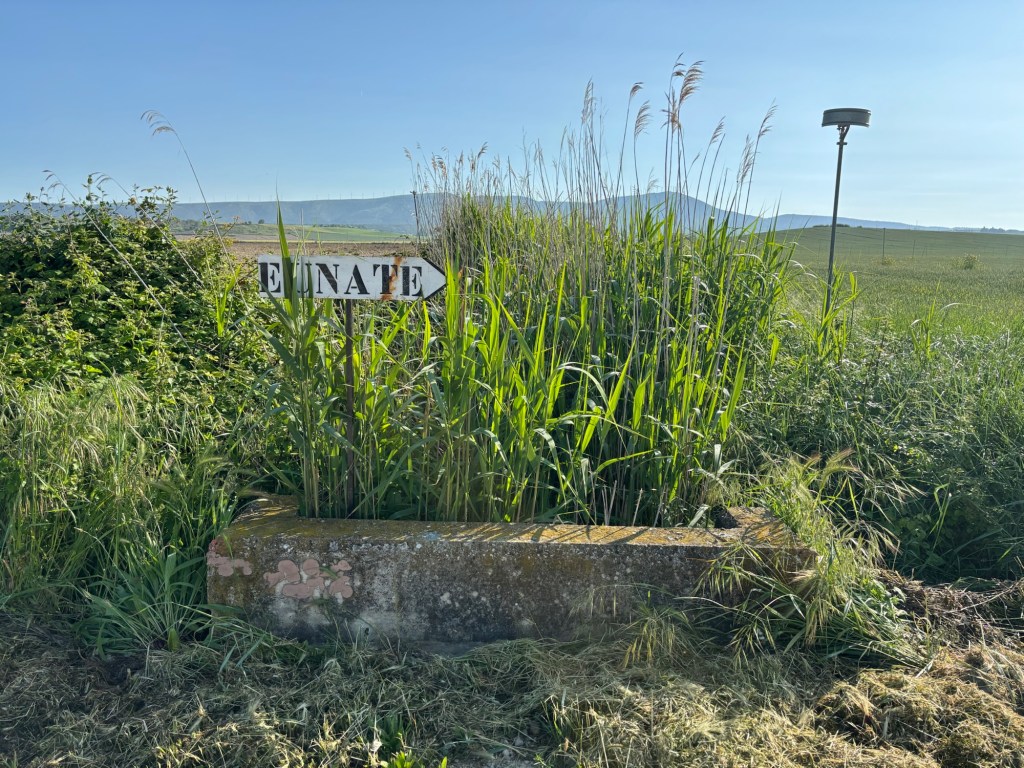
It felt funny to leave the well-marked Camino, but I soon found that the road to Eunate was well-marked, too.

It was a quiet walk through open fields, some of which were recently harvested white asparagus, which is more popular in Europe than the green kind.

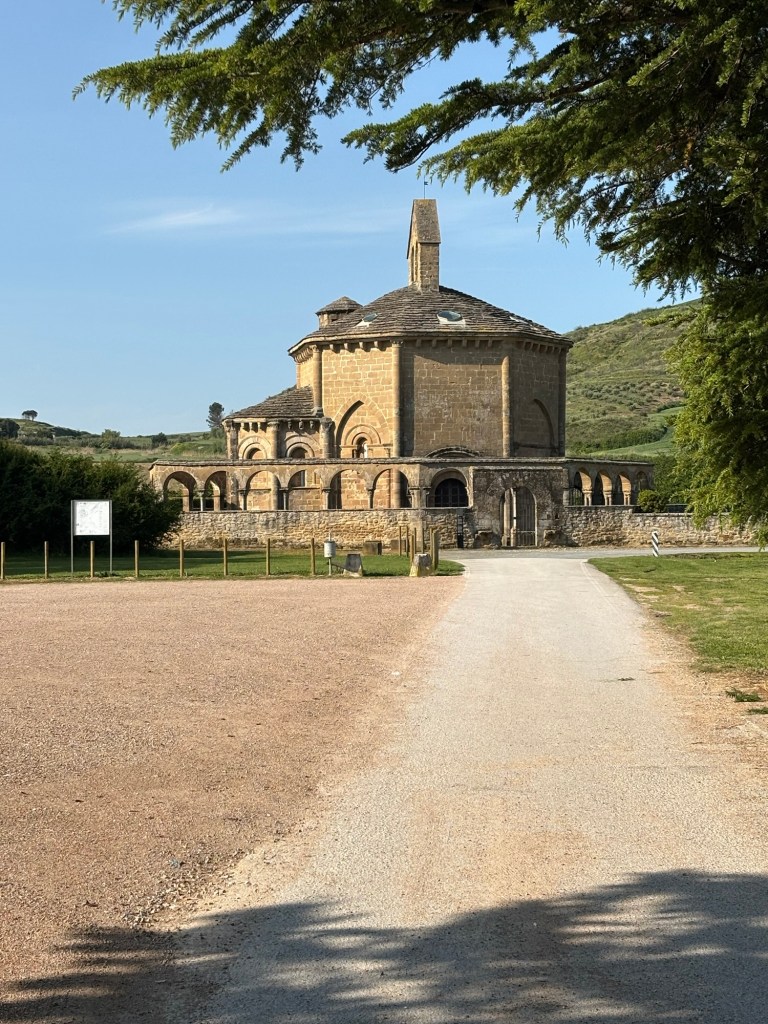
For a few moments I caught a glimpse of the church way out there.

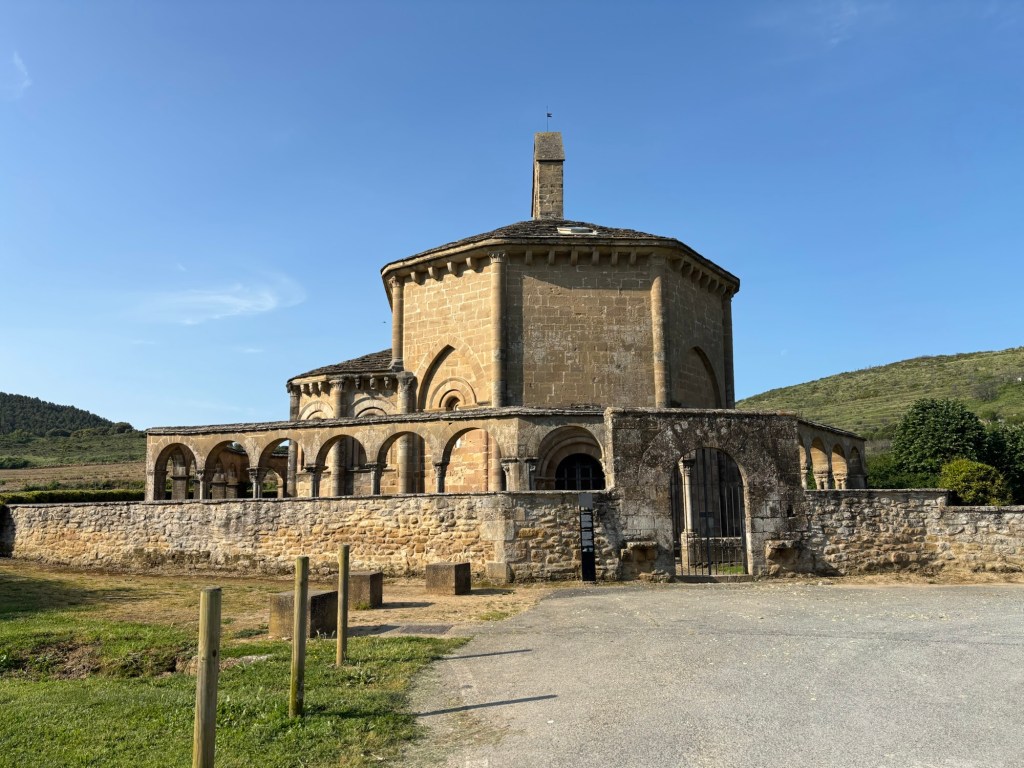
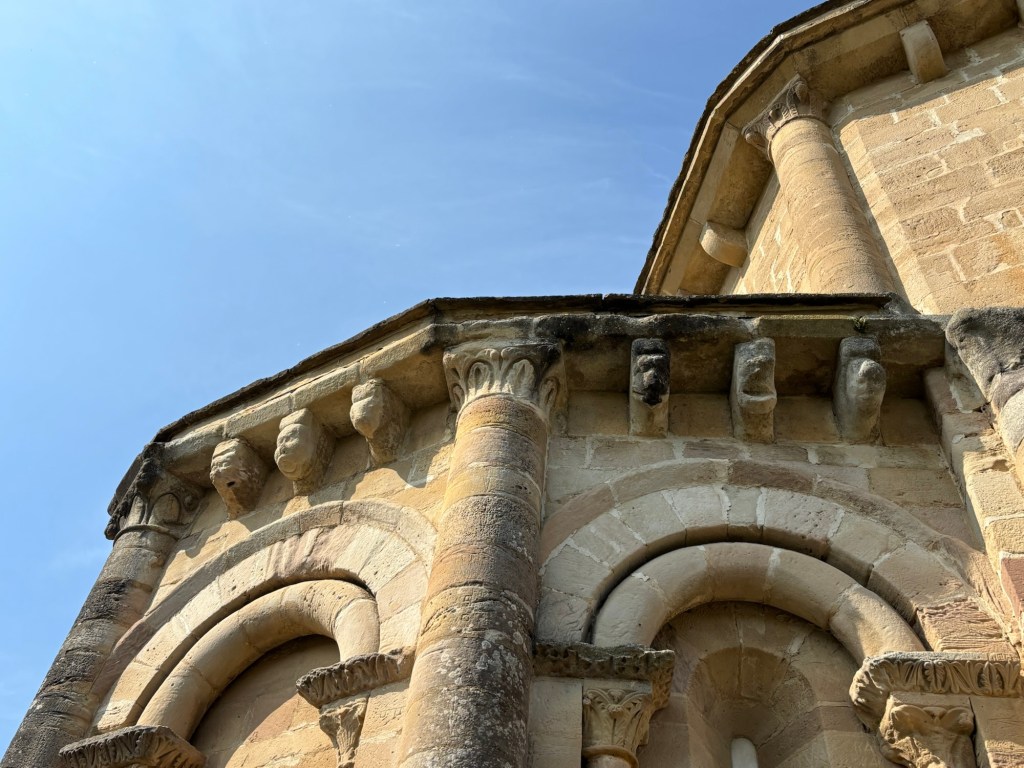
The church of Santa Maria de Eunate is unique in a number of ways. One, it’s all by itself out in the countryside, which is unusual for a medieval church. No one really knows why it was built. It could’ve been a burial chapel, and there’s good reason to think it was built by the Knights Templar, who were very involved on the Camino. Its octagonal shape is similar to the lines of the church in Torres del Rio and the Church of the Holy Sepulcher in Jerusalem which were both built by the Knights Temples lar.

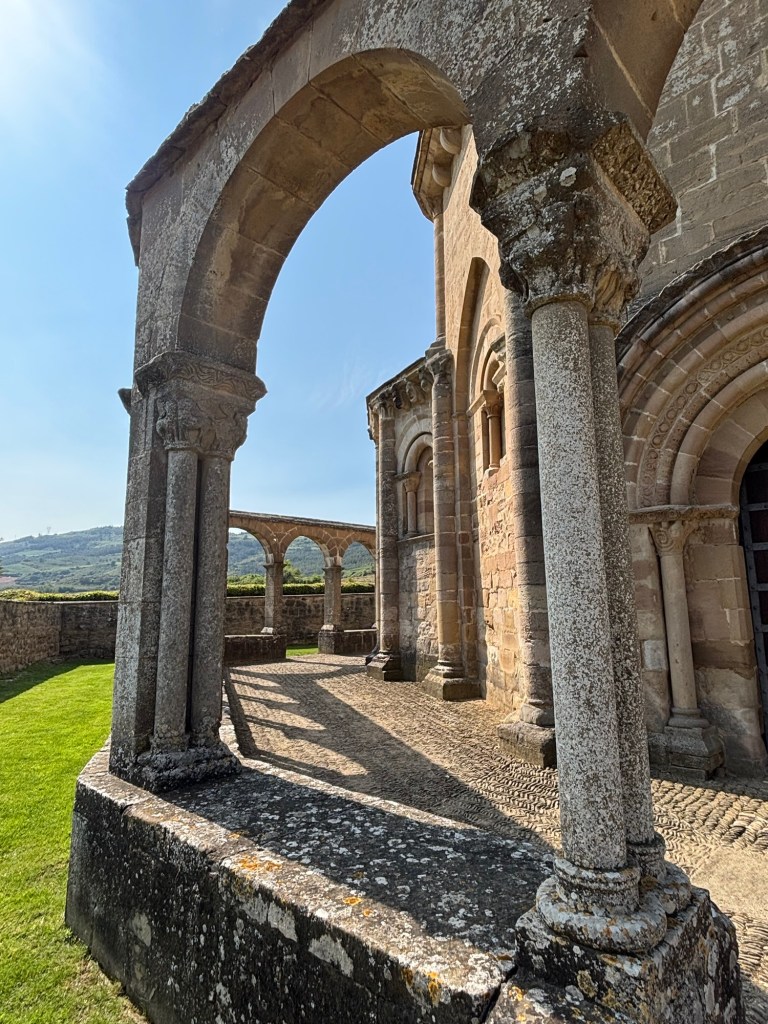
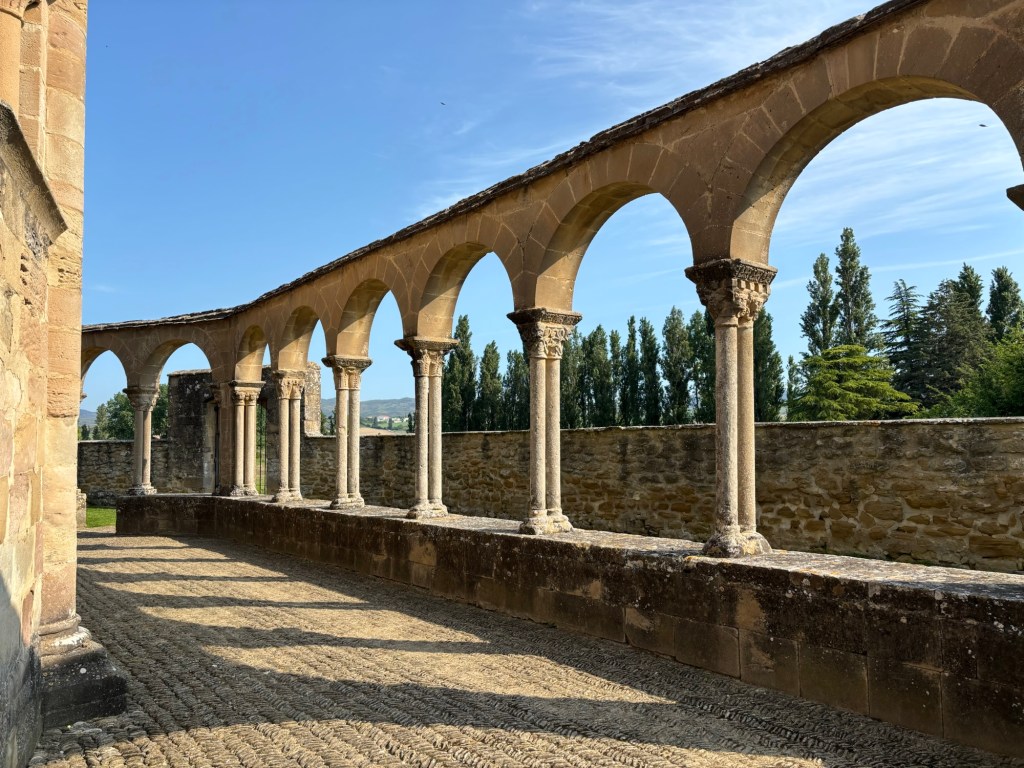
Eunate also has a separate unattached arcade surrounding it. That’s totally unique.

The word Eunate mean 100 doors in the Basque language. Scholars think that there’s sacred geometry involved at Eunate. There are 33 openings in the arcade. Jesus lived 33 years which is considered a sacred number. If you go around the arcade three times, you get 99, plus the front door equals 100.

I walked up to it at 9:30, just before it opened. An American woman I’d met the night before at the albergue in Uterga was already there, and it was fun to have someone who spoke English there to talk about it.

Once the gate was open, I slowly took my time walking around the outside of the church.

It was built in the twelfth century, so it’s ancient, and like many churches along the Camino from that era, Romanesque in style.

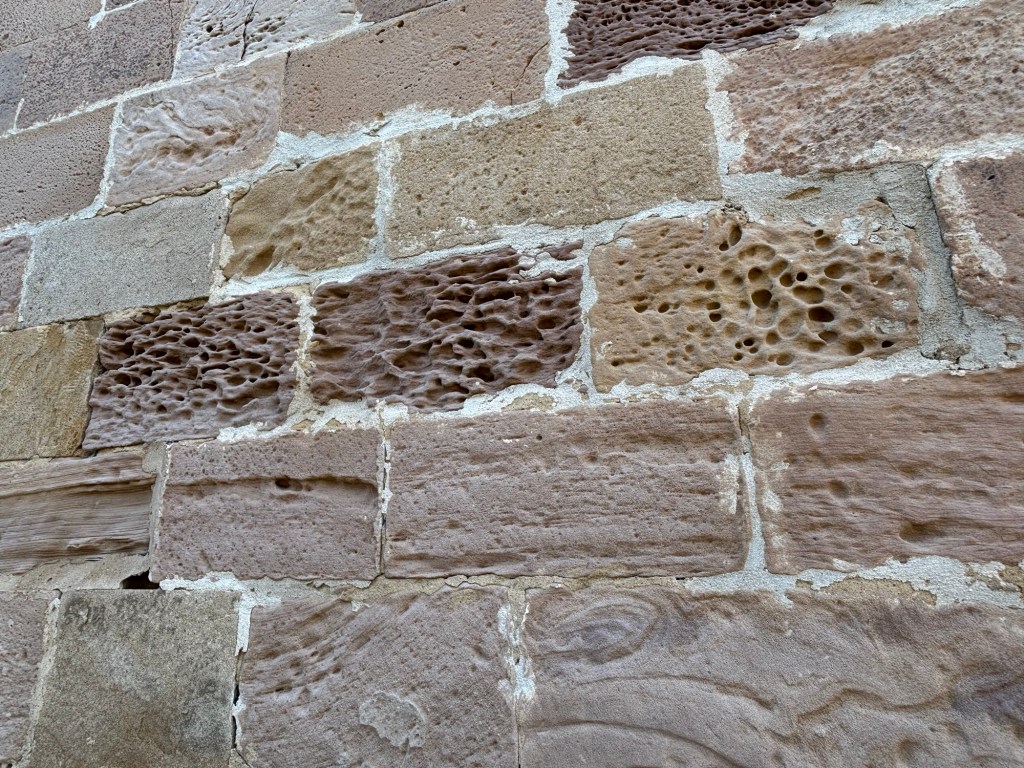
The stone is quite worn, and has an interesting texture.

Stone on outside wall of Eunate

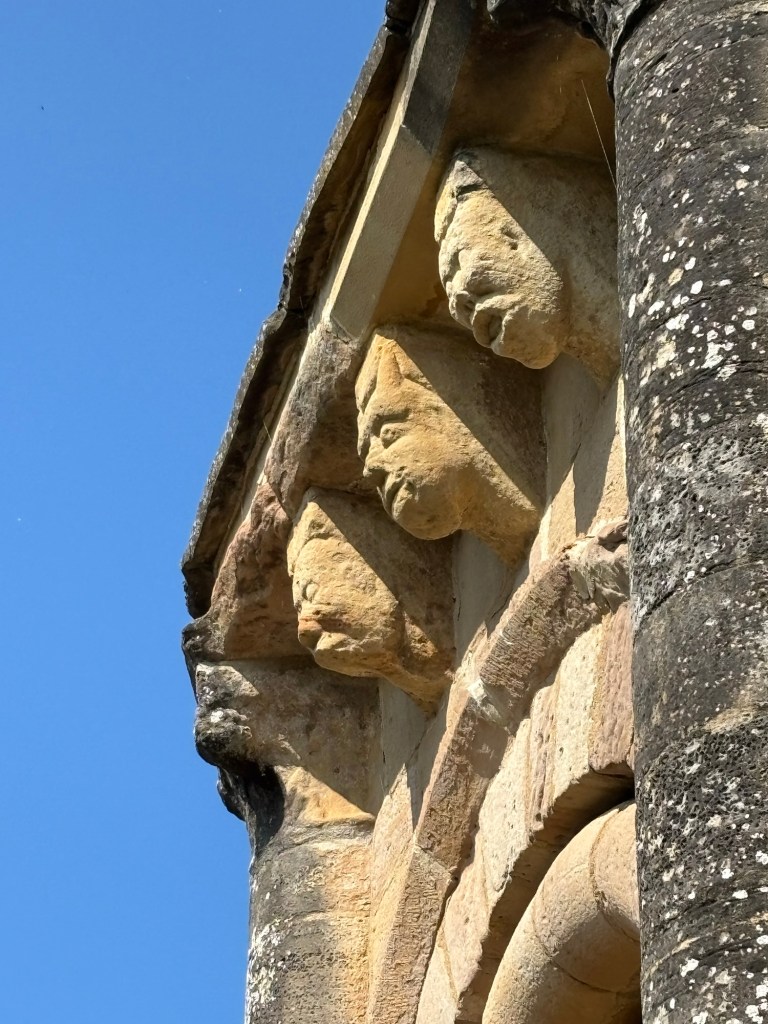
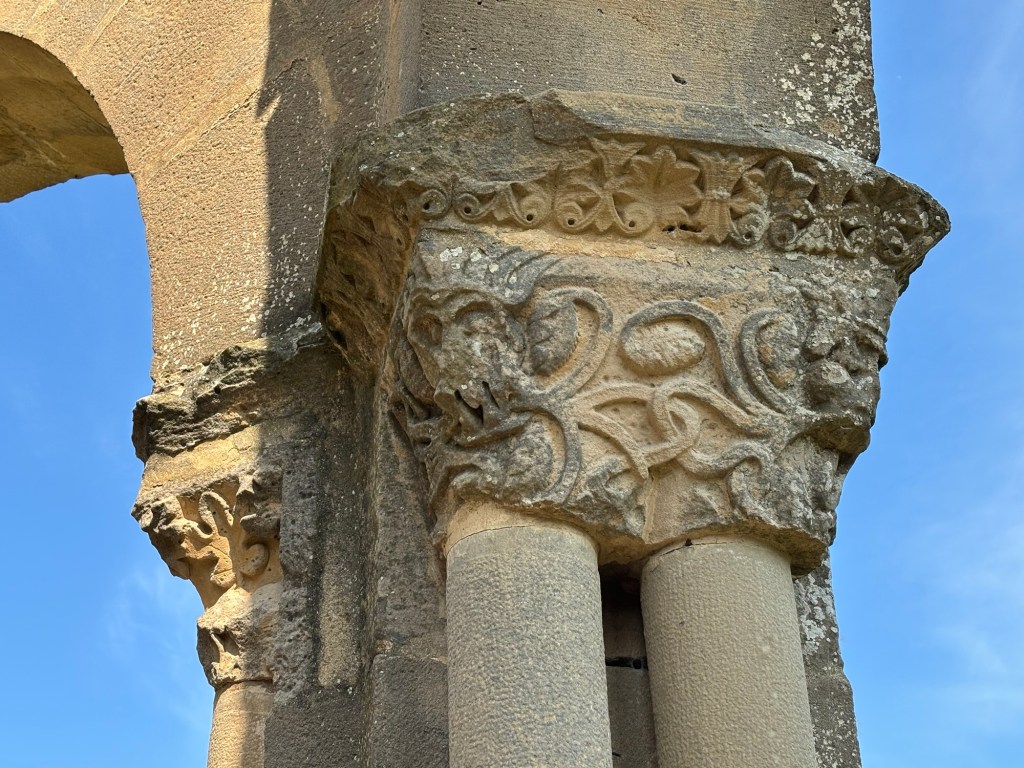
Looking up, there are carvings of heads around the edge. Some have noted that the faces, though worn, have features that could be Moorish.

There were so many churches being built at that time along the Camino, that groups of artisans, artists and builders came from France and other parts of Europe and worked as teams on church after church. Historians think this could be one of the churches built by these international builders.

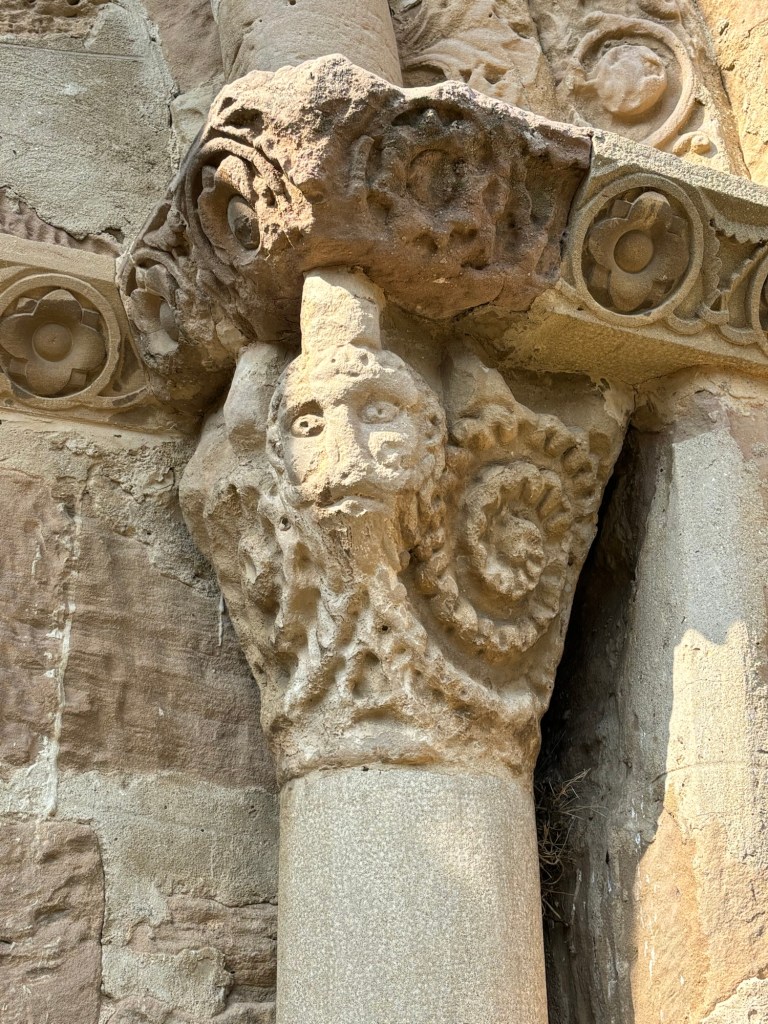
There are some fanciful carvings, too. On a corner capitol there’s a man with a spiraling beard.

A man with a spiraling beard

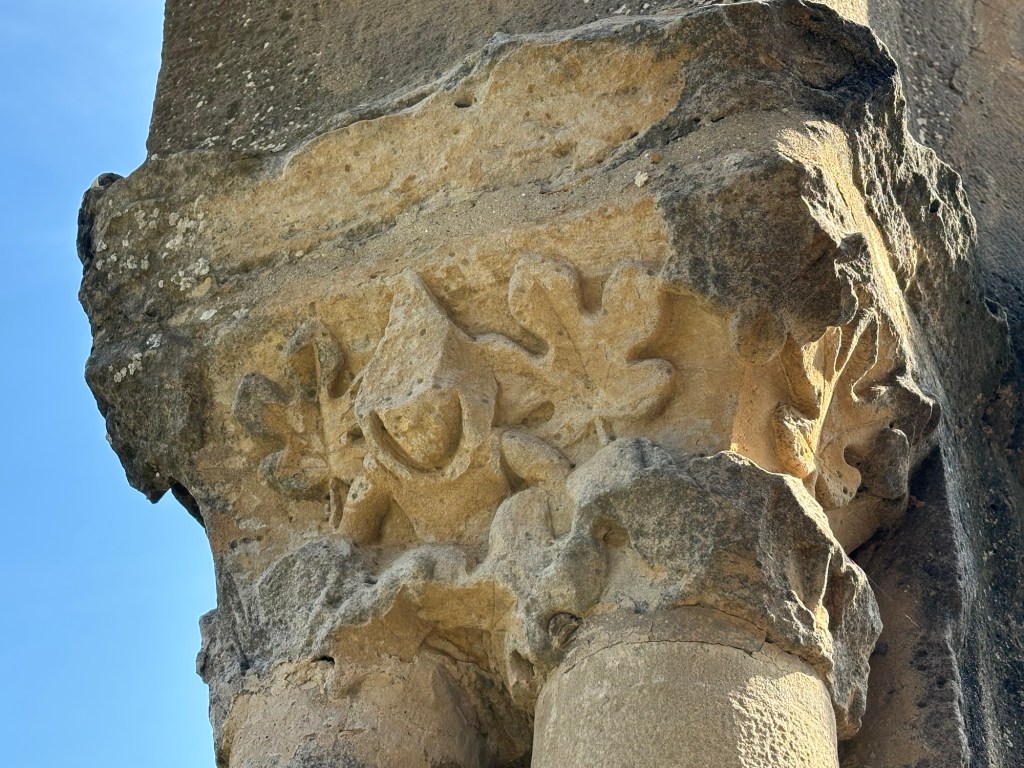
The capitols on one half of the arcade also have unusual carvings. What are those creatures that look like lions?

The arcade is quite beautiful the way it encircles the church. It does remind me of the circular movement of the labyrinth.

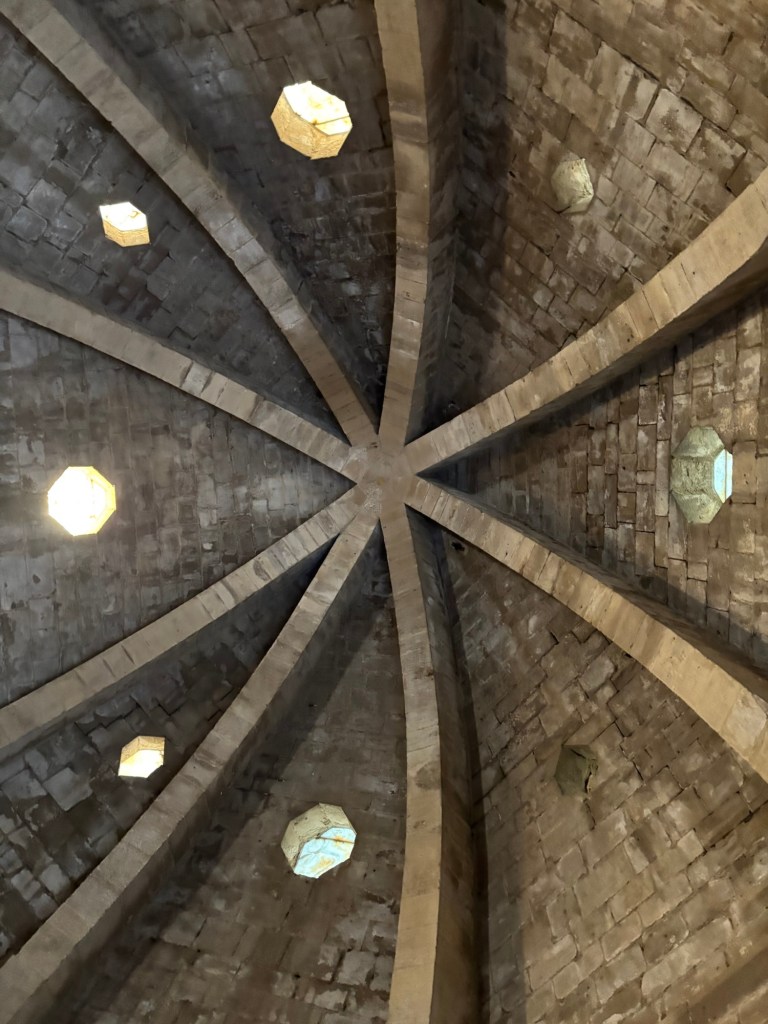
The interior is very simple. The windows are alabaster not stained glass. And there are alabaster skylights.

Now I wish I’d taken more photos inside.

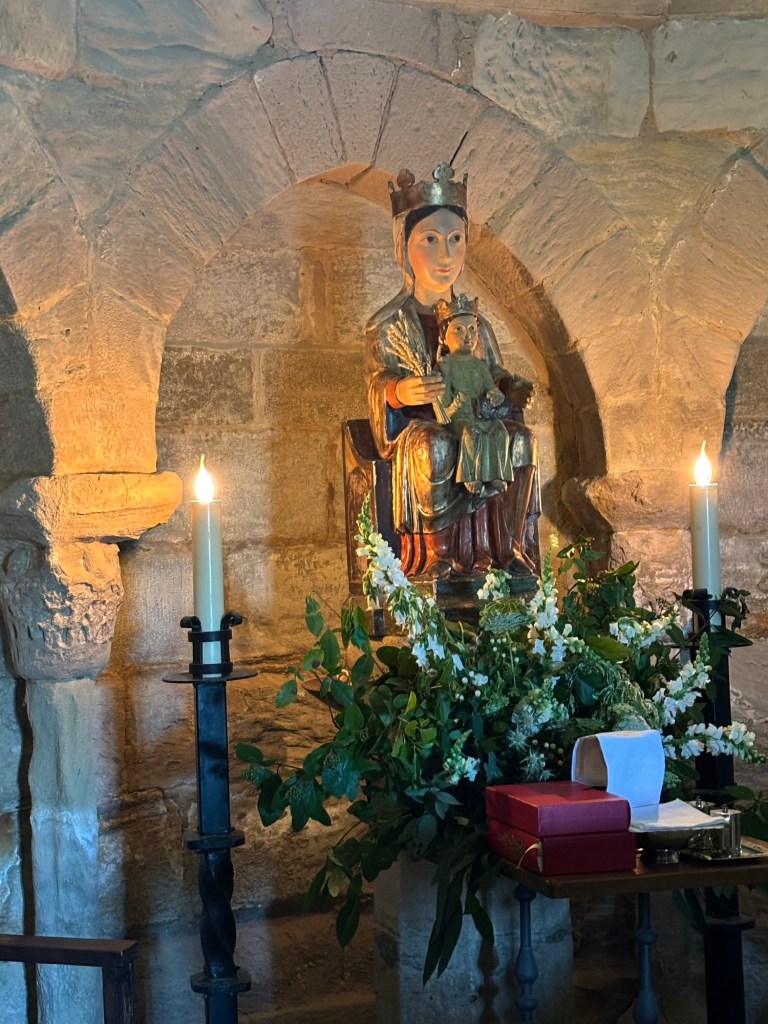
At the center of the church sits the Virgen de Eunate. She is actually a copy because the original disappeared in the 1970’s. I’m intrigued by that because medieval Spanish Virgens had a habit of moving around on their own volition. And sometimes they were discovered in caves or trees.

The Virgen from the opposite angle

I sat in silence in the church taking in the shape of the space and the focus on the beautiful Virgen. She holds a sheaf of wheat as well as the Christ child, both symbols of abundance, it seems to me.

There is a quiet energy to the space, a barely perceptible feeling that I enjoyed. I love how the apse has columns and an arcade that echoes the one outside. The church feels centered and almost modern the way its unadorned by gold retablos and random saints or the more usual impression of stained glass. The alabaster windows let in a quiet shaded light. The place feels grounded in the earth; it has been there for 800 years!

I was hoping there’d be a mass there on Sunday, but it’s only celebrated on special occasions. There’s an association of friends of Eunate that support it, and weddings are held there.

While I was visiting a group of people arrived with folding tables, food and wine, and set up a private party in the old albergue next door. They weren’t very interested in answering my inquiries. That’s ok, sometimes in Spain I realize that I am very much a guest from another culture.

When it was time to walk on to Obanos, I had some questions about the way back. Someone told me, oh no, don’t take that trail. Finally, I consulted Apple Maps and started down the trail anyways. It led through a field of wildflowers.

When I got to a T, I had to choose left or right on a wider trail that went into the bright green wheat fields. Just then, a Mom and her teenage son walked by and pointed me in the right direction towards Obanos. They said “Buen Camino” and walked on talking animatedly together. They reminded me a bit of the Virgen and her son at Eunate.

Local Mother and son on the path to Camino
and Obanos

I’m so glad I took the road not taken, and said yes to Eunate.

Categories: Camino de Santiago, Pilgrimage | Tags: , , , , , | 2 Comments

A little pre-Camino Magic

“The Camino Provides,” and “Camino Magic,” are terms that get thrown around a lot. In my experience they’re both true; I’ve found what I needed on the Camino, and received many more unexpected blessings. This time I experienced both here in Pamplona before I even started walking.

About ten years ago I lent some of my Camino books to a Nancy Reynolds, a fellow pilgrim I met on Facebook. We got together for coffee several times, and later, when I was Interim at St. Anne’s, Fremont, she came down with a friend to attend church on a Sunday and sit in on my presentation on the Camino.

At that point, Nancy already had a long association with the Camino. Then she started a company called “The Camino Experience,” where she serves as a coach and guide for groups of pilgrims making their first Camino. She meets them in St. Jean Pied-de-Port, builds community among the group, and helps them start over the Pyrenees, and on through Pamplona, where they all stay at the same Pension. She’s a wonderful resource.

I kept up with Nancy online and I was thrilled when I discovered her podcast, “You on the Camino.” It’s so good! She breaks down how to prepare for a Camino in a clear, step by step process, and poses great questions. She also interviews people preparing to walk and those who’ve returned.
That reflection piece is important and the need for it is underestimated. The Camino is a transformative journey that can continue to transform us if we listen to our experience and incorporate what we’ve learned into our life after the Camino.

As I was prepping for this trip I checked out Nancy’s “Camino Experience” website and saw that she and I would overlap in Pamplona. So I reached out and we made plans to reconnect while we were both here.

Yesterday we met for a delicious, long lunch at a restaurant where the Camino enters Pamplona. It was meaningful to talk with her about my pilgrimage as well as her work on the Camino with pilgrims. It was so much fun, we did it again today!

We agreed that the Camino is all about connection, transformation, and…Camino Magic.

If you’re interested in walking the Camino, be sure to check out Nancy’s podcast, “You on the Camino” wherever you get your podcasts. You can find the link to her company “The Camino Experience” on the homepage of the blog.


Categories: Camino de Santiago, Conversations on the Camino, Pilgrimage, Sharing the Camino, Spiritual Growth | Tags: , , , , | Leave a comment

Blessing Shells (and Pilgrims) for the American Pilgrims on the Camino, Northern California Chapter

My remarks and blessing at the annual Shell Ceremony, March 1, 2025:

Being a pilgrim on the Camino means we go on pilgrimage.  Pilgrimage can mean different things to different people:  it can be the traditional religious pilgrimage to Santiago to visit the relics of St. James; it can be a spiritual journey where we challenge ourselves and live in the moment; it can be an adventure we feel called to take on. It can be a physical challenge.  There’s usually some kind of challenge involved.

Being a pilgrim means that we’ve felt a call to go out of our comfort zone and explore something beyond ourselves, and usually to explore inwardly as well.

The author Phil Costaneau writes in “The Art of Pilgrimage” that pilgrimage is about making travel sacred. Those of you who are walking this year, I encourage you to ask yourself, “Why am I walking?” and let that question live in your heart and listen to what comes up for you as you walk. 

The most recent issue of La Concha, the magazine of American Pilgrims on the Camino,  has reflections on “Keeping Time,” by pilgrims who share their experience of being on pilgrimage as a way to mark transitions or other significant events in their lives. That was true for me.

I walked the Camino Frances for the first time in 2013 after I left my position at a church in Menlo Park.  I was turning 55 and I saw an opening of time to walk the Camino.  I wanted to discern what was next.  Our kids were almost done with college.  I was also ready for a grand adventure. 

In June of 2013 Hale and I took a driving vacation in France that ended in SJPP.  It was like being dropped off at college.  We said goodbye at the Puerto de España, on the Camino just outside of St. Jean Pied de Port, and he drove off to Bordeaux and flew home. 

Suddenly, I was traveling alone.  For about a few uphill hours, I felt on my own…because I stopped at Orisson for the night and found a community of pilgrims.  I remain friends with several pilgrims I met at that first dinner. We just met up with Monika in Vienna last October. 

When you step onto the Camino you enter the stream of pilgrims. You’ve entered a community, and, like in life, you also walk your own journey.

The Camino taught me the hard way that we each have our own pace.

My ankle said “enough” in San Juan de Ortega after too many days of walking too far, too fast.  I had to cut my Camino short and go home hobbling. 

But I was fortunate to return in October and make it to Santiago.  I had a new sense of purpose, to walk my own Camino.  I discovered a “flow state” within myself, of being alive in body, mind and spirit. 

As a person of faith, I felt the presence of God along the Camino in many ways:  in my fellow pilgrims, in the beauty of Spain, and the Spanish people; the history, the art, the culture, the food; the feeling that we are walking the path that pilgrims like us have walked for over 1,000 years. 

There is a definite sense of spiritual energy along the Way, I hope you feel it, too.  The Camino invites us to BE ALIVE and BE THANKFUL for life.

I’m excited to be returning to walk a portion of the Camino Frances in May, from Pamplona to Burgos.  This time around I want to give thanks for becoming a grandmother.  I want to give thanks for the lives of my parents who lived long lives and died five years ago. I’ve been studying Spanish and I’m looking forward to speaking Spanish with the wonderful people of Spain hosting us along the Camino. 

I look forward to that rhythm of walking poles and footsteps that becomes a walking prayer.  People have asked me to pray for our country. I will pray for our country, and the world in which our grandchildren and all our children are growing up in.

These days you can find me preparing to walk the Camino.  I’m walking the streets of Alameda, around Lafayette Reservoir, Lake Merritt, and in Joaquin Miller park. 

And I hope to see some of you fellow pilgrims on the Camino.

Blessing of the Shells

We gather today from all across Northern California

To share a meal, share our stories, our hopes and dreams

To build a community of pilgrims

To support our fellow pilgrims as they prepare to walk

The many routes to Santiago.

Now, let us gather all the love from this group,

the love of the spirit of the Camino

And the thread of love that connects all humanity

To bless these shells,

symbols and talismans of the pilgrimage. 

May these shells identify each of you as a pilgrim on the Way

May they protect you and keep you safe

May they always remind you

That you are walking the ancient way of St. James.

Buen Camino and Amen.

Categories: Blessings, Pilgrimage | Tags: , , , , , , , , | 2 Comments

My last day of walking the Camino: The Long Story

Setting out on my last day walking the Camino from Mansilla de las Mulas.

Setting out on my last day walking the Camino from Mansilla de las Mulas.

I walked the Camino Frances in three trips. Camino 1.0 was from St. Jean-Pied-de-Port to Burgos, in June, 2013. Camino 2.0 was from Leon to Santiago, in October 2013. That left the section in the middle from Burgos to Leon for my Camino 3.0, in April, 2015.

That’s the short story of why I was walking into Leon on April 19th, 2015.

After 10 days of walking from Burgos,  I was in Mansillas de las Mulas, only 18 kilometers away from Leon. Here’s the long story of what that day was like.

The night before I walked into Leon I was seriously thinking of taking a taxi because one of my ankles was hurting and when I talked with my husband on the phone, it seemed like the logical thing to do. The walk into Leon was known to be tedious, and lots of pilgrims bussed through it. When I began my second Camino, in October 2013, from Leon, I took a taxi out past the suburbs, and I didn’t regret it.

But when I got up the next morning to head out from Mansilla de los Mulas towards Leon, I felt I needed to walk at least part of the way. I decided I’d see how I felt as the day unfolded.

I had mixed feelings about finishing my Camino 3.0, and finishing the whole Camino in general.

Sign just outside Mansilla de las Mulas

Sign just outside Mansilla de las Mulas

The April trip was empowering. I totally enjoyed the walking, the solitude, and the conversations along the way. Every day I felt physically challenged and spiritually fulfilled. The Camino was as magical as it had been before. Each of my three trips had its own flavor, its own season (summer, fall, and now spring) and each trip took me deeper into the spirituality of walking solo. Camino 3.0, across the Meseta, had been more contemplative than the other two trips, more like a retreat.

There was something very attractive about the sureness of following the yellow arrows on the Camino.  But now the adventure was about to end, and I found myself feeling of sad and wrestling with the feelings of “what’s next?”  I didn’t want Camino 3.0 to end.

When I was a kid I had the habit of saying, “Oh, it doesn’t matter.” My Mom used to respond with, “No, everything matters,” which would make me angry. I realize now that I used to say “It doesn’t matter,”  when I couldn’t express my feelings very well, and that my Mom said “No, everything matters,” to help me.  But she didn’t quite know how to get me to open up and share what was going on inside.  As an adult, and a Mom myself, I realized how frustrating it must have been for her to try and help me process my feelings.

I still struggle with that feeling of emotional ambiguity as an adult, and I was in one of those frustrating “Oh it doesn’t matter” kind of moods as I left Mansilla de las Mulas, and I spent a lot of the day debating whether I should call a taxi or not.

Even on the last day of walking, the Camino had something to teach me.

In the morning, I prayed for strong ankles, and to be open to what the Spirit wanted me to learn. I ate a late breakfast at my beautiful little hotel in Mansilla de las Mulas with the group of Irish women walking together I’d met the night before.

Javier saying

Javier saying “Buen Camino!”

Javier, the owner of the hotel, said “Buen Camino,” and waved me onto the Camino.   He was one of the many gems of hospitality I’d met along the Way.

The 18 kilometers to Leon were not scenic, or beautifully empty, like the Meseta. But there were memorable moments.

Hill fort where the ancient Asturians lost their battle against the Romans.

Hill fort where the ancient Asturians lost their last battle with the Romans.

There was the hill fort at kilometer 3 where the ancient Asturians lost their struggle with the Romans. Right in front of it was a gas station.  I love the juxtapositions of eras along the Camino!  There was a long, medieval bridge at kilometer 6 that was still used by cars. A modern pedestrian bridge had been built alongside it for the pilgrim traffic.

The 20 span Puente Ingente over rio Moro

The 20 span Puente Ingente over rio Moro

I ducked into a village church in Villamorros in the middle of a Mass, and was happy to see a young girl assisting the priest at the altar.  At about kilometer 9, my left ankle began to hurt again. It was midday, and it was hot for April. The Camino was shunted under highway overpasses, and ran next to junkyards.

The Camino meets billboards for the Macy's of Spain

The Camino meets billboards for the Macy’s of Spain

Junkyard Dog outside of Leon

Junkyard Dog outside of Leon

That was the low point.  For the first time since I’d left home, I wondered about how safe it was to be walking alone. Why was I doing this again?

The guidebook said there was an albergue and café just up ahead in Arcahueja. Maybe that’s where I would call my taxi.  When I got to the cafe, I found the five nice Irish women I’d met in Mansilla hanging out. They looked pretty out of sorts, too. We said, “hello” and complained a little about the heat.

Cafe/Bar La Torre in Arcahueja

Cafe/Bar La Torre in Arcahueja

I asked the bartender how far it was to Leon. He said it was only 11K, and “there’s a beautiful view of the city just up ahead.” (I’m sure he tells everyone that!) I asked if a bus stopped in the village or if they had a taxi. “No” he said. Hmmm.

I ordered a slice of tortilla, two deviled eggs, and a café con leche. What should I do? I felt bone tired and was so tempted to call a taxi. My food arrived, and I realized I was ravenous.

Once the protein in the eggs and the tortilla  kicked in, it became clear to me that I really needed to walk the entire way into Leon, and make Camino 3.0 a Cathedral to Cathedral affair.  As my Mom would have said, “it mattered.”

Once I finally got clarity, I felt the need for some encouragement to make it into Leon.

I had an idea. I turned on my phone and checked into the American Pilgrims on the Camino Facebook page. It was 4 a.m. in California, and 7:00 a.m. on the East Coast. Someone must be up and reading the page. I posted that I was 11 K out of Leon and was tempted to take a taxi, and needed some support. I posted it on this blog, too.

Immediately, waves of energy started rolling into that little café in Arcahueja through my iPhone! “You can do it! Don’t quit! Feel the burn!” Over a hundred people responded, cheered me on, and sent prayers via the APOC Facebook page. My brother-in-law in Washington, D.C. saw the post on the blog and gave me a big PUSH.

The Camino taught me—again—that sharing my feelings and asking for support is ok. Feeling vulnerable is ok. It’s usually in those moments when God reaches through our stoic armor and touches us.  My unspoken prayers during my morning’s walk were answered.

I said “Buen Camino” to the Irish crew and headed back out on the Camino, now excited to continue. The guy behind the bar had exaggerated just a little though; it was a long time before I saw the view of Leon.

The last hill before I could see the city of Leon

The last hill before I could see the city of Leon

I passed big box stores, and auto dealerships, and medieval churches with storks nesting on top of them.

The funny thing was, my ankle stopped hurting completely. It was amazing.  I picked up the pace.  There seemed to be very few other pilgrims walking that afternoon.

The Camino crossed the Autovia (freeway) on a dedicated pedestrian bridge, and the amount of concrete and apartment buildings reminded me of my long walk into Santiago in the rain, in October of 2013. But weather was good, and I was very thankful.

Out in the distance I could see the Cathedral in Leon, with the snowy mountains behind it. How I wished I could keep walking on to Astorga and beyond. It was a new experience to know what was up ahead on the Camino. That’s when I knew that I had almost finished the whole Camino Frances.

Cathedral at last, but still a long ways off.

The Cathedral in view at last, but still a long ways off.

Walking from the bar in Arcahueja to the Cathedral took about two hours of brisk walking. I felt great, aligned in my purpose. The feelings of sadness about finishing were still there, but I didn’t blow them off by calling a taxi. I walked and felt sadness and joy, and was determined to finish strong.

Once past the newer parts of Leon, passing apartment blocks and crossing roundabouts, The Camino bridged a small stream and led me through the ancient city walls.

It continued into a tangle of medieval streets and spit me out on the grand avenue in front of the building designed by Gaudi. Suddenly, I knew where I was. The Cathedral was just up ahead. And then I was standing in front of it, looking up at its fantastic exterior.

Approaching the Cathedral

Approaching the Cathedral

It was nearly 4:00 p.m. on a Sunday afternoon, and the doors were closed for Siesta.

When the adrenalin subsided, the sad feelings welled up again. No one was there to celebrate my arrival, and I had a wave of homesickness. But Mary was there, up on her pedestal outside, by the locked doors, holding baby Jesus in her arms, and she was smiling.

Mary holding Christ

Mary holding Christ

Thank you for being there, Mary.

Mary greeted me, and sent me off to my hotel to check in and relax. I was grateful for the lessons I’d learned that day. I wasn’t really alone. The Spirit was with me, and I felt blessed by the wave of energy and love from my fellow Pilgrims back in the States that had swept me on, to finish Camino 3.0, and the entire Camino.  Amen.

Categories: April 2015, Camino de Santiago, Leon, Pilgrimage | Tags: , , , , , , , , | 9 Comments

Blog at WordPress.com.